Diesel Engine High Idle RPM: 7 Causes and How to Fix It
04/08/2026
Common Rail Injector Problems: 6 Signs & Expert Solutions
04/13/2026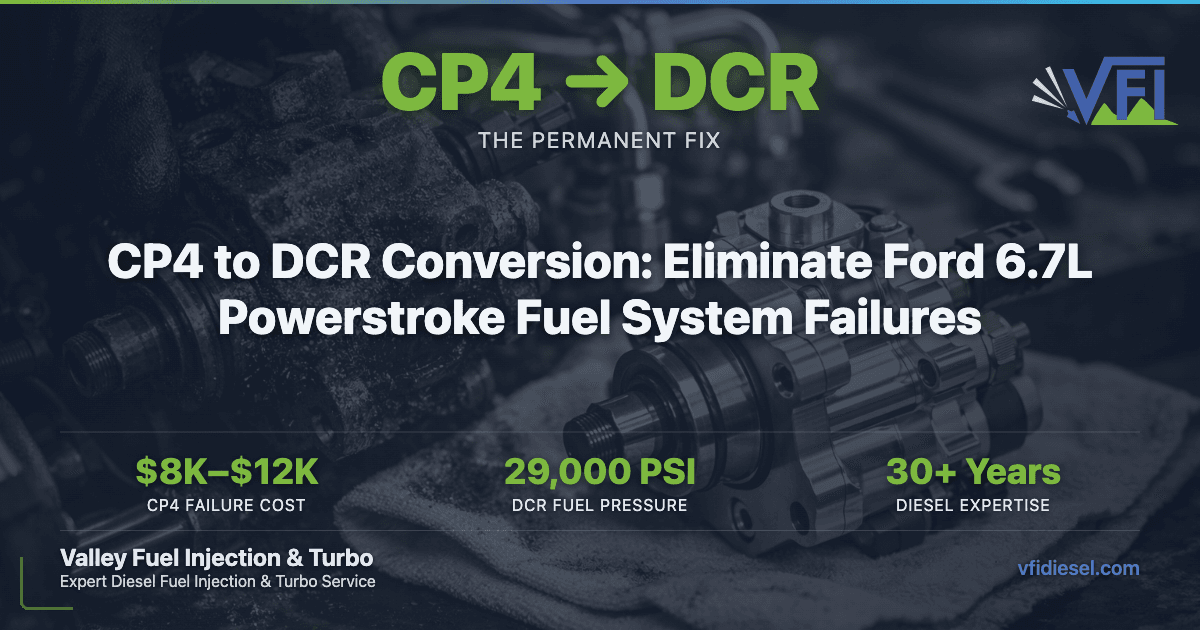
The CP4 to DCR conversion has become the gold standard solution for Ford 6.7L Powerstroke owners tired of catastrophic fuel system failures. After rebuilding thousands of diesel fuel injection systems over 30 years, we’ve seen firsthand how CP4.2 pump failures destroy entire fuel systems, and how a DCR conversion replaces the CP4 and removes its specific failure mode.
Converting from the CP4.2 to the S&S DCR pump, co-developed by S&S Diesel Motorsport and PurePower (the aftermarket arm of Stanadyne), replaces the CP4 and removes its specific failure mode, though it costs more upfront.
Why Does the CP4.2 Pump Fail on Ford 6.7 Powerstroke Engines?
The CP4.2 has a well-known failure pattern on North American diesel fuel. Earlier Power Stroke engines used HEUI on the 7.3L and 6.0L and a Siemens common-rail system on the 6.4L. The CP4.2 relies on internal lubrication from diesel fuel, a critical weakness when dealing with low-sulfur diesel fuel that lacks adequate lubricity.
We see CP4.2 failures caused by several interconnected issues:
Inadequate Internal Lubrication: The CP4.2’s high-pressure piston and cylinder require constant lubrication from diesel fuel. Ultra-low sulfur diesel (15 ppm), required for U.S. highway diesel since 2006, has less natural lubricity than the fuel it replaced. ASTM D975 caps the wear limit, but the CP4.2 has little margin for fuel near that limit, for water, or for off-spec fuel.
Contamination Sensitivity: When CP4.2 internal components wear, they generate metal particles that contaminate the entire fuel system. These particles flow downstream through fuel lines, fuel rails, and into injectors, causing system-wide damage that can cost $12,000–$18,000+ to repair.
CP4.2 failure often occurs without warning. The pump can fail catastrophically during normal operation, leaving you stranded and facing extensive fuel system contamination.
Fuel Quality Dependence: Biodiesel blends, water contamination, and fuel additives can accelerate wear patterns.
What Is a DCR Pump and Why Is It More Reliable Than CP4?
The S&S DCR pump is a different design from the CP4.2. The DCR pump runs on the truck’s fuel supply. The S&S kit has fuel lines only; it adds no engine-oil lines.
Robust Internal Components: DCR pumps feature heavier-duty pistons, cylinders, and cam systems. The pump housing and internal tolerances are built to withstand higher pressures.
CP4 to DCR Conversion: What Does the Process Involve?
A proper CP4 to DCR conversion requires more than simply swapping pumps: it involves installing the kit’s new fuel lines. Here’s what we do during every conversion at our Woodland facility:
Preventive swap (CP4 still good)
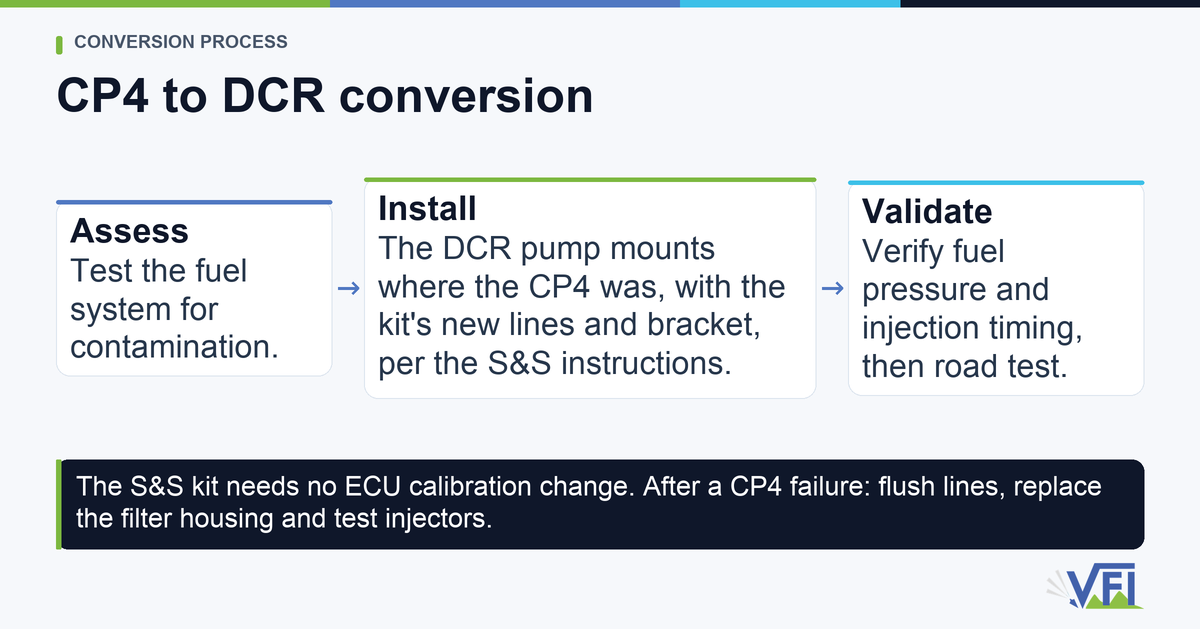
Pre-Conversion System Assessment: We start by testing the entire fuel system to determine contamination levels.
DCR Pump Installation: The DCR pump mounts in the same location as the CP4 and uses the new fuel lines and bracket that come in the S&S kit, installed per the S&S instructions.
Engine Management: The S&S Ford DCR conversion requires no ECU calibration change. In California, the 6.7F-DCR-1 kit is covered by CARB Executive Order D-756-7 for 2011 to 2023 Ford 6.7L trucks.
System Testing and Validation: After installation, we perform comprehensive testing including fuel pressure verification, injection timing checks, and road testing to ensure optimal performance.
After a CP4 failure (contamination repair)
If the CP4 has already failed, we also flush all fuel lines, replace the fuel filter housing, and test injectors on our Bosch-certified test bench, then follow the same installation and testing steps.
If the CP4 has already failed, replace the fuel filter housing as part of the contamination repair. It can hold metal particles that would reach the new DCR pump. This step saves thousands in potential warranty issues.
Cost Analysis: CP4 Replacement vs DCR Conversion Investment
DCR conversion costs more upfront than CP4 replacement. Here is how the numbers compare.
CP4 Replacement Costs: A new CP4.2 pump with installation typically ranges from $4,500–$7,000+ depending on parts brand and labor rate. However, this doesn’t address the fundamental reliability issues.
DCR Conversion Investment: Complete CP4 to DCR conversion ranges from $4,500–$8,500 depending on the specific DCR pump model and any additional fuel system repairs needed.
Hidden CP4 Failure Costs: When CP4 pumps fail catastrophically, repair costs extend far beyond pump replacement. Contaminated fuel systems require injector replacement ($5,500–$8,500), fuel line flushing ($800–$1,400), and fuel rail cleaning ($500–$1,000).
Downtime and Towing Expenses: CP4 failures often occur without warning, leaving trucks stranded. Towing costs, rental vehicle expenses, and lost productivity can add $2,000-$5,000 to total failure costs.
Our analysis shows that trucks experiencing two CP4 failures spend more than DCR conversion costs while still facing future reliability issues. For detailed cost comparisons, see our fuel injection pump cost analysis guide.
Why Choose a Bosch-Authorized Shop for Your CP4 to DCR Conversion?
DCR conversion requires specialized knowledge and access to genuine components, capabilities that separate professional diesel facilities from general repair shops.
Factory Training and Certification: Our technicians complete ongoing training through Bosch programs.
Genuine Component Access: As an authorized dealer for Bosch, Delphi, and Alliant Power, we source genuine components directly from manufacturers. This ensures proper fit, performance, and warranty coverage.
Advanced Diagnostic Equipment: Our common rail service equipment includes the latest Bosch and Delphi programming interfaces.
Comprehensive System Knowledge: With over 30 years of diesel fuel injection experience, we understand how DCR conversions interact with other engine systems. This prevents compatibility issues and ensures optimal long-term performance.
Warranty and Support: We provide comprehensive warranties on DCR conversion work and maintain ongoing relationships with component manufacturers for technical support. This gives you confidence in both immediate performance and long-term reliability.
When you’re ready to replace your CP4, schedule a consultation with our team. We’ll assess your specific truck’s condition and provide detailed conversion recommendations based on your operating requirements. For fleet operations in Sacramento and throughout Northern California, we’ve helped operators transition entire fleets to DCR systems.
For Ford 6.7L Powerstroke owners throughout Northern California and Nevada, DCR conversion replaces the CP4 and removes its specific failure mode.
Call us at 530-668-0818 to discuss DCR conversion for your Ford 6.7L Powerstroke. We serve customers throughout Northern California and Nevada, and we ship DCR conversion components nationwide for qualified installers.
Frequently Asked Questions
How long does a CP4 to DCR conversion take?
A complete CP4 to DCR conversion typically takes 8-12 hours depending on the specific truck configuration and any additional fuel system repairs needed. We usually complete conversions within 1-2 business days.
Will DCR conversion affect my truck’s warranty?
DCR conversion may affect your Ford warranty depending on the specific warranty terms and truck age. However, most trucks requiring DCR conversion are beyond the original powertrain warranty period. We recommend consulting with your dealer before conversion if warranty coverage is a concern.
Can I convert to DCR before my CP4 fails?
Yes, preventive DCR conversion is often the most cost-effective approach. Converting before CP4 failure avoids the fuel system contamination a failed CP4 causes and reduces total conversion costs.
What maintenance does a DCR pump require?
The DCR pump runs on the truck’s fuel supply; the S&S kit adds no engine-oil lines. No special fuel additives or treatments are required. Because the pump runs on fuel, keep up with fuel filter service.
Will DCR conversion improve my truck’s performance?
DCR conversion maintains stock performance levels while improving reliability. Some owners report slightly improved fuel economy due to more consistent fuel pressure control, but the primary benefit is eliminated CP4 failure risk rather than performance gains.