

Diesel Turbo Surging at Cruise: Causes & Fixes
05/29/2026
Summer Diesel Fuel System Problems: Heat & Prevention
06/10/2026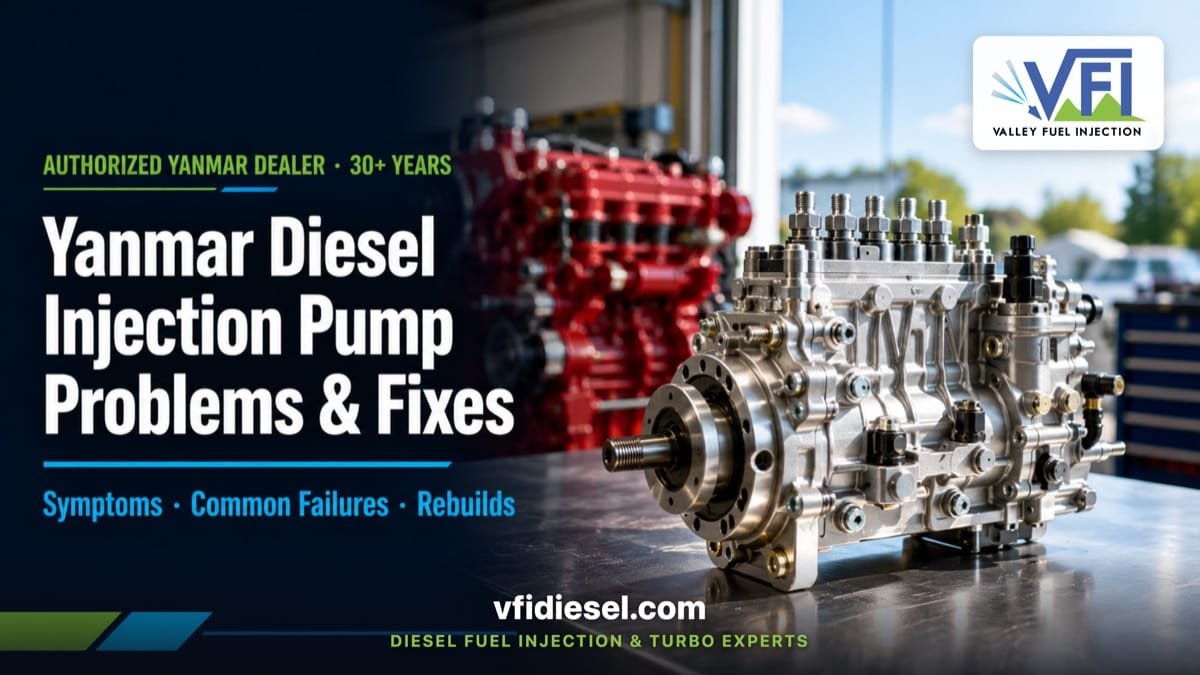
Yanmar Diesel Injection Pump Problems: Symptoms, Common Failures & Rebuild Options
Yanmar diesel injection pump problems tend to show up quietly at first, a little harder starting on cold mornings, a slight drop in power under load, maybe a puff of smoke you chalk up to the weather. By the time the symptoms become obvious, the pump is often well past the point of simple maintenance.
As an authorized Yanmar dealer with over 30 years of diesel fuel injection experience, we’ve rebuilt and tested hundreds of Yanmar injection pumps across compact tractors, marine engines, and light construction equipment. This guide covers everything you need to know: how to spot a failing pump early, what causes these failures, and whether a rebuild, exchange, or replacement makes the most sense for your machine.
In our shop, most Yanmar injection pump failures come on gradually, not all at once. Catching the early symptoms, rough idle, hard starting, black smoke under load, and getting a proper bench diagnosis can save you from a full pump replacement. As an authorized Yanmar dealer, Valley Fuel Injection can test, rebuild, and recalibrate your pump to factory specifications, often for significantly less than a new OEM unit.
What Type of Injection Pump Does Yanmar Use, and How Does It Differ by Series?
Yanmar uses several pump types, and the specific pump design varies significantly depending on the series and application. Read the pump tag before ordering parts. Understanding which pump your engine uses matters because it directly affects how the pump is diagnosed, rebuilt, and sourced.
The most common Yanmar pump families you’ll encounter in the field:
- TNE series (2TNE, 3TNE, 4TNE): These are the workhorses of the compact tractor and skid steer world. Many use Yanmar’s MP-type distributor pump (YPD-MP2/MP4); others use inline pumps. The TNE family is well-supported for rebuild parts, and cores are generally available.
- TNV series (3TNV, 4TNV): The newer successor to the TNE, built from Tier 2 through Tier 4. The TNV family includes common-rail engines; the 3TNV88C and 4TNV98C are examples. Many mechanical TNV engines use the MP-type distributor pump. Common in newer compact tractors, mini-excavators, and generators.
- Marine series (1GM, 2GM, 3JH, 4LH, 6LY): Yanmar marine injection pumps vary by model. The 4LH series used both VE-type distributor pumps and YPES inline pumps, and the 6LYA uses YPES inline pumps. Match the exact engine and pump before ordering parts. Marine pump rebuilds trend toward the upper end of the cost range because of parts scarcity and the precision required for marine calibration.
- Industrial/construction (4TNV, 4TNE, 3TNM): Found in forklifts, compact excavators, and light construction equipment. Pump access can be challenging on some platforms, which adds labor time to any R&R job.
Unlike common rail systems, which use a high-pressure supply pump and electronically controlled injectors, Yanmar’s mechanical pumps meter and pressurize fuel for each cylinder in a single unit. This makes them more repairable than modern common rail components. You can read more about how common rail systems differ on our common rail service page.
Yanmar has been manufacturing diesel engines since 1933 and is one of the few manufacturers that still produces small-displacement diesel engines for agricultural and marine use. Their mechanical pump design has remained fundamentally similar across decades, which is part of why experienced injection shops can rebuild them effectively. Learn more about Yanmar’s engineering history at Yanmar’s official site.
What Are the Most Common Yanmar Injection Pump Failure Symptoms?
Yanmar injection pump problems follow a recognizable pattern, and most symptoms appear well before the pump fails completely. Here’s what to watch for:
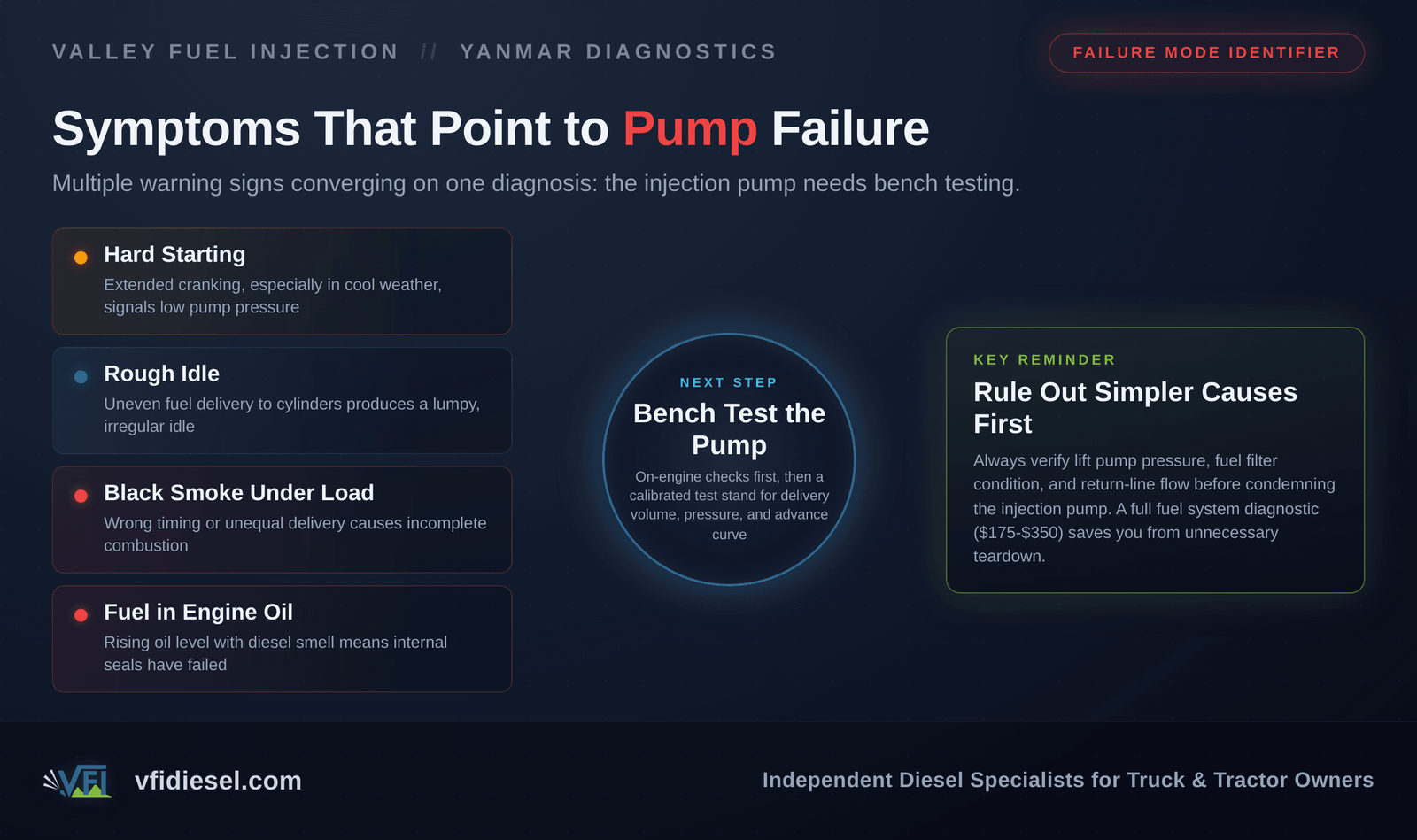
Hard Starting or Extended Cranking
A healthy Yanmar should fire within a few seconds of cranking, even in cool weather. If your engine is cranking longer than usual before it catches, the pump may not be building adequate pressure to initiate combustion. This is one of the earliest and most reliable indicators of pump wear. It can also point to a failing fuel shutoff solenoid or a lift pump that isn’t delivering adequate supply pressure, both of which need to be ruled out before condemning the injection pump itself.
Rough Idle or Uneven Running
A worn injection pump that delivers unequal fuel quantities to each cylinder will produce a lumpy, uneven idle. On a 3-cylinder engine, this is especially noticeable because there’s less cylinder overlap to smooth things out. If the engine smooths out under load but idles roughly, worn plunger-and-barrel assemblies are a likely cause.
Loss of Power Under Load
If your tractor, excavator, or marine engine bogs down under loads it used to handle easily, the pump may not be delivering enough fuel volume at the required pressure. This symptom is easy to misattribute to a clogged fuel filter or air in the system, and those should always be checked first, but persistent power loss after basic maintenance points toward the pump.
Black or White Smoke
Once a plugged air filter and bad injectors are ruled out, black smoke under load usually means the pump is delivering fuel at the wrong timing or in unequal quantities. White smoke at startup that clears quickly is normal in cold weather, but persistent white smoke can indicate a timing issue or a pump that’s lost its ability to hold injection pressure. Blue smoke is typically an oil consumption issue, not a pump problem.
Fuel in the Engine Oil
This is a serious symptom that demands immediate attention. If the pump’s internal seals fail, raw diesel can migrate past the pump housing and into the crankcase. You’ll notice the oil level rising and a diesel smell when you pull the dipstick. Running an engine with fuel-diluted oil accelerates bearing wear dramatically. If you see this, stop the engine and get it diagnosed immediately.
Engine Won’t Shut Off
Stop-control design depends on the engine. On the 1GM10 series, pull the cable-operated stop knob with the key ON, hold it until the engine stops, then turn the key OFF. On engines that use a fuel shutoff solenoid, a solenoid that fails in the open position will keep the engine running after shutdown. This is often misdiagnosed as an injection pump problem, but it’s usually a solenoid issue, a much less expensive fix.
If you notice your engine oil level rising or smell diesel in the crankcase, do not continue operating the equipment. Fuel-diluted oil loses its lubricating properties rapidly, and continued operation can cause catastrophic bearing failure. Shut down and have the fuel system inspected before restarting.
Talk to a Diesel Tech Yanmar hard to start, smoking or down on power? Tell us the engine model, serial number and symptoms. We bench-test Yanmar injection pumps against factory specs and quote the rebuild or exchange before any work starts. Two ways in: drive it into our Woodland shop near Sacramento, or ship it to us from anywhere in the country. ☎︎ Call 530-668-0818Out of the area? Start a mail-in rebuild → |
What Causes Yanmar Injection Pumps to Fail Prematurely?
Yanmar injection pumps are built to last, but several factors can shorten their service life significantly. Understanding the root causes helps you avoid repeat failures after a rebuild.
Fuel Quality and Contamination
Fuel quality and contamination are the most common cause of premature injection pump failure we see, and Yanmar is no exception. The plunger-and-barrel assemblies inside a mechanical injection pump are machined to tolerances measured in microns. Contaminated fuel, whether from water intrusion, dirt, or microbial growth in stored fuel, acts as an abrasive that accelerates wear on these precision surfaces.
Agricultural and marine equipment is especially vulnerable because it often sits for extended periods between uses, allowing moisture to condense in fuel tanks and microbial colonies to establish themselves in the fuel.
The EPA’s diesel fuel standards set baseline quality requirements, but fuel sitting in a tank for months degrades regardless of its initial quality. If your equipment sits seasonally, a quality fuel stabilizer and biocide additive are worth the investment.
Weak or Failed Lift Pump
The injection pump relies on the lift pump (also called the supply pump or transfer pump) to deliver fuel at adequate pressure and volume. When the lift pump weakens, the injection pump has to work harder to draw fuel, which accelerates internal wear. A lift pump that’s failing intermittently is one of the most common reasons we see injection pumps come in with wear patterns that don’t match the engine’s age or hours. We cover this in more detail in our post on diesel injection pumps losing prime.
Extended Service Intervals and Neglected Filters
Yanmar specifies fuel filter replacement intervals for a reason. A clogged primary or secondary fuel filter starves the injection pump of flow and creates cavitation. On compact tractors used in dusty agricultural environments, filter intervals should be shortened from the factory recommendation, not extended.
Incorrect Fuel Additives or Biodiesel Blends
Biodiesel blends above what the engine’s operation manual allows can degrade rubber seals inside older Yanmar injection pumps. Some aftermarket fuel additives marketed as injector cleaners are too aggressive for mechanical pump internals. When in doubt, stick to additives specifically approved for use with mechanical injection systems.
Timing Drift and Advance Mechanism Wear
Many Yanmar mechanical pumps, including the MP-type distributor pump, use an advance (timer) mechanism to adjust injection timing with engine speed. Over time, the advance mechanism can wear, stick, or seize, causing timing to drift. Retarded timing produces black smoke and power loss; advanced timing causes hard starting and can damage pistons. A seized advance mechanism is a common finding when we tear down high-hour Yanmar pumps.
If your Yanmar equipment sits for more than 60 days between uses, add a diesel fuel stabilizer and biocide before storage if the engine’s operation manual allows additives, run the engine for 10 minutes to circulate treated fuel through the injection system, and top off the tank to minimize the air space where condensation forms.
How Is a Yanmar Injection Pump Tested and Diagnosed Correctly?
Proper diagnosis of a Yanmar injection pump requires more than plugging in a scan tool. Mechanical pumps need to be evaluated with a combination of on-engine testing and bench testing to get an accurate picture of what’s actually failing.
On-Engine Diagnostic Steps
Before pulling the pump, a qualified technician should verify the basics: fuel supply pressure from the lift pump, fuel filter condition, return line flow, and injection timing. A full fuel system diagnostic at a California specialty shop typically runs $175–$350 and includes lift pump pressure testing, injector return-flow measurement, and a timing check. This step is critical because it rules out simpler causes and gives the technician a baseline before teardown.
Bench Testing
Once the pump is removed, bench testing on a calibrated injection pump test stand is the only way to accurately measure delivery volume, pressure, and timing across the full RPM range. We test each pump against Yanmar’s factory specifications for delivery quantity per stroke, pressure rise, and advance curve. This tells us exactly which internal components are worn and whether the pump is a candidate for rebuild or needs to be replaced outright.
Injectors should be bench-tested at the same time. Our injector testing and repair service covers this process in detail.
Yanmar publishes factory service data that specifies exact delivery quantities and pressure values for each engine series. Without access to these specifications, a shop is essentially guessing at calibration, which is why working with an authorized dealer matters.
If you’re a diesel technician or equipment owner who wants to understand the full diagnostic process, our diesel fuel injection services page outlines how we approach testing across all pump types.
Is It Better to Rebuild, Exchange, or Replace a Failed Yanmar Injection Pump?
This is the question most Yanmar owners face once a pump failure is confirmed, and the right answer depends on the pump’s condition, parts availability, and the value of the equipment it’s in. We’ve written a detailed breakdown in our diesel injection pump rebuild cost vs. replace guide, but here’s how it applies specifically to Yanmar pumps.
Rebuild (Bench Service)
For most TNE and TNV series pumps in reasonable condition, an injection pump bench rebuild is the best value. The pump is disassembled, inspected, worn components are replaced (seals, gaskets, delivery valves, plunger-and-barrel sets as needed), and the pump is recalibrated on the test stand to factory specifications. A Yanmar injection pump rebuild at a California specialty shop typically runs $550–$950 for the bench service alone, not including R&R labor. Remove and reinstall labor adds another $310–$500 depending on the platform and access difficulty.
Rebuild makes the most sense when: the pump core is in good structural condition, the engine has reasonable remaining service life, and the equipment’s value justifies the investment.
Exchange (Remanufactured Unit)
If your pump core is too far gone for rebuild, seized advance mechanism, scored bores, cracked housing, a remanufactured exchange unit is the next option. Remanufactured Yanmar injection pumps for common TNE/TNV tractor applications typically run $750–$1,400 for the unit, plus a core charge of $150–$300. Marine and industrial pumps trend toward the upper end of that range because cores are scarcer and OEM-spec calibration is more demanding. We participate in an injection pump exchange program that can reduce turnaround time significantly.
New OEM Replacement
New OEM Yanmar injection pumps are available through authorized dealers, but the cost is substantially higher than a quality rebuild or remanufactured unit. For most compact tractor and construction equipment applications, a pump rebuilt and calibrated to Yanmar factory specs is a sound alternative to new. Our rebuilds carry our 1-year, unlimited-mileage warranty on parts and labor (30 days on electrical parts). New OEM makes the most sense for marine applications where the cost of a failure at sea outweighs the price premium, or for equipment under active warranty.

Prices reflect typical California specialty-shop ranges as of 2026. Your actual quote depends on the condition of your specific components, the engine series, parts availability, and current labor rates. Marine and industrial pump platforms typically run 25–40% higher than compact tractor applications due to parts scarcity and calibration complexity. Call VFI at 530-668-0818 for an accurate quote on your job.
One important note: when you’re already pulling the injection pump, it almost always makes sense to test the injectors and the lift pump at the same time and fix what fails. The labor overlap is significant, and a freshly rebuilt pump working against worn injectors or a weak lift pump will wear prematurely again. Our approach mirrors what we described in our post on John Deere injection pump problems, treat the whole fuel system, not just the component that failed.
If you’re shipping a pump to us for bench rebuild, clean the exterior before packaging and include as much information as possible: engine model, serial number, hours of operation, and a description of the symptoms. This helps us pull the correct factory calibration data before we even open the pump. We accept mail-in injection pumps and injectors for testing and rebuild from customers nationwide.
What Should Yanmar Equipment Owners Know About Finding an Authorized Service Center?
Not every diesel shop has the equipment, training, or factory data to properly rebuild and calibrate a Yanmar injection pump. Here’s what separates a qualified shop from one that’s guessing.
Authorization and Factory Training Matter
Valley Fuel Injection is an authorized Yanmar dealer for engines, parts and service, which means we have access to factory service data, calibration specifications, and genuine OEM parts. This isn’t just a marketing distinction. Yanmar’s factory calibration data specifies exact delivery quantities and pressure values for each engine series and application. Without that data, a shop is calibrating by feel rather than by specification, and the results show up as poor performance, excessive smoke, or premature wear after the rebuild.
You can verify authorized Yanmar service centers through Yanmar’s official U.S. dealer locator. For fuel injection-specific work, look for shops that are also certified by Bosch or another major injection system manufacturer, since that certification indicates they have calibrated test equipment and trained technicians.
What to Ask Before Leaving Your Equipment
Before authorizing any injection pump work, ask the shop these questions:
- Do you have a calibrated injection pump test stand, and can you test to Yanmar factory specifications?
- Will you test the lift pump and injectors as part of the diagnosis?
- Are you using OEM or quality aftermarket parts for the rebuild?
- What warranty do you offer on the rebuilt pump?
- Do you have experience with this specific Yanmar engine series?
A shop that can’t answer these questions confidently is not the right place for precision injection work. Our team at Valley Fuel Injection has been doing this work since 1993, and we’re happy to walk you through our process before you commit to any service.
Shipping Your Pump to a Specialist
If you’re not in Northern California or Nevada, you don’t have to settle for a local shop that lacks the right equipment. We regularly receive injection pumps and injectors shipped from customers across the country through our mail-in rebuild service. The pump is tested on arrival, rebuilt to factory specification, and shipped back with a detailed test report. For Yanmar owners in areas without a qualified injection specialist nearby, this is often the best option for getting the job done right.
Diesel truck owners and equipment operators in the Sacramento area can also visit our Sacramento diesel fuel injection service page, and those in the broader Northern California region can find us at our Woodland location.
Whether you’re dealing with hard starting, power loss, or smoke you can’t explain, our team can pinpoint the problem and give you an honest assessment of your options. Call us at 530-668-0818 or schedule a diagnostic. We’re located at 1243 E Beamer St, Suite C, Woodland, CA 95776, and we ship rebuilt pumps and injectors nationwide.
Frequently Asked Questions About Yanmar Diesel Injection Pump Problems
What shortens a Yanmar injection pump’s life?
In the failures we see, the primary cause is almost always fuel quality or a neglected lift pump. Equipment that sits seasonally is at higher risk because of fuel degradation and moisture contamination during storage. Regular fuel filter changes and proper storage practices are the most effective ways to extend pump life.
Can I rebuild a Yanmar injection pump myself?
Technically yes, but it’s not advisable without a calibrated test stand and factory calibration data. The plunger-and-barrel assemblies inside a Yanmar mechanical pump are matched pairs machined to micron-level tolerances. Reassembling the pump without verifying delivery quantities and timing on a test stand will result in a pump that runs, but not to specification. You’ll likely see poor fuel economy, smoke, and premature wear. The cost of a professional bench rebuild is almost always justified compared to the risk of a DIY calibration that’s off-spec.
What’s the difference between a Yanmar TNE and TNV injection pump?
The TNV is the newer successor to the TNE, built from Tier 2 through Tier 4 emissions levels, and both series use more than one pump type. Many TNE and TNV engines use Yanmar’s MP-type distributor pump (YPD-MP2/MP4), others use inline pumps, and the TNV family also includes common-rail engines such as the 3TNV88C and 4TNV98C. Read the pump tag before ordering parts. Rebuild parts for both series are generally available, but TNV components are more expensive and require more precise calibration. Marine and industrial Yanmar pumps vary by model and require specialized calibration data.
Should I replace the injectors when I rebuild the injection pump?
We strongly recommend bench-testing the injectors whenever the injection pump is being serviced. If the injectors are worn, they’ll cause the rebuilt pump to work harder than it should, accelerating wear on the new components. Individual Yanmar injector rebuilds typically run $95–$175 each, and a full set for a 3 or 4-cylinder engine runs $400–$900 for parts. The labor overlap when you’re already doing pump R&R makes this the most cost-effective time to address injectors. Consult a qualified diesel technician to evaluate whether your specific injectors need service or replacement.
Does Valley Fuel Injection service Yanmar marine engines?
Yes. We service injection pumps and injectors for Yanmar marine engines including the 1GM, 2GM, 3JH, 4LH, and 6LY series. Marine pump rebuilds are more complex and more expensive than compact tractor applications because of parts scarcity and the precision required for marine calibration. We also accept mail-in pumps from marine customers who aren’t local to our Woodland, CA shop. Call us at 530-668-0818 to discuss your specific engine and get a quote.


2 Comments
I’m having trouble with an Yanmar. old school 28 hp little tractor. I’d sure like to send my pump to you but the way everything is going between Canada and the states. I’m sure I just can’t chance it but I read all of your info very well put together and very interesting. Thanks.
Hi Zeke,
Thank you for the kind words. We have some customers in Canada we work with. Give us a call +1-530-668-0818 and we can figure something out. You can ask for Alex.
Thanks!