
Kubota V2203 Engine Guide: Variants, Fitment & Fixes
10/06/2026
Diesel injector fault codes are a starting point, not a diagnosis. When your scanner pulls a P0201 or a cylinder contribution code, it’s telling you the ECM noticed something wrong in that circuit or cylinder, but it cannot tell you whether the injector itself is the problem, whether the issue is electrical, mechanical, or fuel-quality related, or whether the “bad” cylinder is actually the one causing the misfire. Getting that answer requires live data, flow testing, and in many cases a certified bench test. This post walks through how to actually read injector codes the way a diesel injection specialist does.
A fault code identifies where the ECM detected a problem, not what caused it. Injector codes in particular are notorious for pointing at the wrong cylinder, the wrong component, or a system-level issue that has nothing to do with the injector itself. Treat every injector code as a lead, not a verdict.
What Fault Codes a Diesel Injector Actually Throws
Diesel injectors generate two broad categories of fault codes: circuit codes and performance codes. Understanding which type you’re looking at changes everything about how you proceed.
Circuit codes (P0201 to P0208, plus the circuit low and circuit high codes) indicate the ECM detected an electrical fault in the injector circuit for that cylinder. This could be an open circuit, a short to ground, a short to power, or a driver failure inside the ECM or injector driver module. The injector itself may be perfectly fine. A broken wire, a corroded connector, or a failed driver will throw the same code as a dead injector.
Performance codes are more nuanced. On common rail engines they show up as cylinder contribution/balance codes, injection timing codes, or injector learning-limit codes, where the ECM has run out of room to trim one injector. The ECM is watching how much correction it has to apply to keep each cylinder contributing equally. When one cylinder consistently needs more or less than the others, a code sets. But the cause could be a worn injector, a partially blocked or leaking injector, low compression in that cylinder, air in the fuel, or even ECM software.
| Code Type | What the ECM Detected | Possible Root Causes |
|---|---|---|
| P0201 to P0208 (Circuit) | Electrical fault in an injector circuit | Broken wire, bad connector, failed ECM or module driver, shorted injector |
| Cylinder Contribution / Balance | Cylinder not contributing equally to power output | Worn injector, blocked tip, low compression, air in fuel |
| Injection Timing / Learning Limit | Injector timing or learned correction outside the ECM limits | Drifting or sticking injector, wrong trim code, ECM software |
| Injector Trim / IQA (P268A) | Injector calibration code not learned or programmed | Replacement injector installed without its code entered |
| Rail Pressure (P0087, P0088) | System pressure not meeting commanded target | Lift pump or filter restriction, failing CP3/CP4, regulator fault, leaking injectors |
Diesel Injector Fault Code Chart: Cummins, Duramax and Power Stroke
Codes that start with P0 or P2 use the generic definitions in SAE J2012, the standard behind OBD-II trouble codes, so P0201 points at the same circuit on a Ram, a Chevy or a Ford even when the factory wording differs slightly. Codes that start with P1 belong to the manufacturer. The first chart covers the generic injector codes. The second shows what factory service bulletins actually traced those codes to on each platform.
Generic Injector Codes (SAE J2012)
| Code | What It Means | Check First |
|---|---|---|
| P0201 to P0208 | Injector circuit, cylinders 1 to 8. Ram words it “Fuel Injector 1 Circuit/Open,” GM “Cylinder 1 Injector Control Circuit.” | Connector, harness and the injector’s electrical specs before the injector itself. On some trucks the published fix was a PCM software update. |
| P0261, P0264, P0267, P0270, P0273, P0276, P0279, P0282 | Injector circuit low, cylinders 1 to 8. The code right after each one (P0262, P0265 and so on) is circuit high. | One cylinder: that injector’s wiring. All eight at once: the driver module or its power supply, not eight injectors. |
| P0263, P0266, P0269, P0272, P0275, P0278, P0281, P0284 | Cylinder contribution/balance, cylinders 1 to 8. That cylinder is not adding its share of crankshaft speed. | Compression, injector delivery, air in the fuel. Run a contribution or cut-out test before condemning the injector. |
| P020A to P020F, P021A, P021B | Injection timing, cylinders 1 to 8. Ram calls P020A to P020F “Fuel Injector Performance.” | Injector response, and check for an ECM software update. |
| P02CC to P02DB | Injector offset learning at its minimum or maximum limit, cylinders 1 to 8 (two codes per cylinder). | The ECM has run out of room to trim that injector: a drifting injector, a wrong trim code, or software. |
| P2146, P2149, P2152, P2155 | Injector group A to D supply circuit. GM’s LML wording for P2146 is “Injector High Control Circuit Group 1.” | A circuit shared by more than one injector. Harness and ECM driver before any injector. |
| P0611 | Fuel injector control module performance. | The driver module (the FICM on a 6.0 Power Stroke) and its power and grounds. |
| P268A | Fuel injector calibration not learned/programmed. | A new injector went in without its trim (IQA) code entered. |
| P0087, P0088 | Fuel rail pressure too low, too high. System codes, not injector codes. | Lift pump, filters, high-pressure pump and regulator first. Injector leak-off comes after. |
What Factory Bulletins Found, by Platform
| Platform | Codes | What It Traced To |
|---|---|---|
| Ram 6.7 Cummins, 2019 | P0087, P008A and P0201 to P0206, with a no-start | Fuel pump failure and fuel system contamination, later covered by recall Y78 (FCA TSB 18-099-22) |
| Ram 6.7 Cummins, 2013–2014 | P0201 to P0206 (Fuel Injector Circuit/Open) | PCM software that made them two-trip faults to “prevent or reduce MIL illumination when no defect is present” (FCA TSB 18-091-16, 18-053-14) |
| Ram 6.7 Cummins, 2015 | P020A to P020F (Fuel Injector Performance), P0301 to P0306 | Listed in a PCM software update, not an injector repair (FCA TSB 18-076-22) |
| Duramax LML, 2015 | P0202, P0204, P0206, P0208 (Cylinder Injector Control Circuit); P2146, P2155 (Injector High Control Circuit Group 1, Group 4) | Engine harness chafed on a tab of the EGR valve gasket. The piezo injectors run on up to 250 volts, and GM says the high-voltage injector wiring is not repairable: replace the harness (GM PIP5198B) |
| Duramax LGH/LML, 2010–2015 | P0087, P0088, P0191, P128E, hard start or no-start | Before a new pump goes in, inspect the pump’s Pressure Regulator 1 for magnetic metal debris. Debris means the whole fuel system gets cleaned and parts replaced (GM PIP4949D) |
| Duramax L5P, 2017–2023 | P0087, P026D (Injection Quantity Too High), P0300 | Metal particles or DEF in the fuel. GM calls for flushing the fuel system before further diagnosis (GM 18-NA-361) |
| Duramax L5P, 2020–2021 | P01CB to P01DA (injection timing retarded or advanced), P020A to P020F, P021A, P021B (injection timing), P02CC to P02DB (injector learning limit) | ECM and TCM software. Update both (GM 22-NA-201) |
| 6.0 Power Stroke | P0611, P1378 (FICM voltage low), U0105, and all eight circuit-low codes (P0261, P0264 and so on) | The FICM or its power and grounds, not eight injectors (MOTOR). Cold hard starts that clear up once warm point to spool-valve stiction: start with oil condition and grade, then Ford TSB 08-26-3, a FICM calibration that heats the injector coils (Alliant Power APTB 01/09) |
| 6.7 Power Stroke, 2017 | P0263, P0266, P0269, P0272, P0275, P0278, P0281, P0284 with a fuel knock at idle | Incorrect learning of injector timing in the PCM. Reset the learned values and reprogram (Ford TSB 18-2015) |
| 7.3 Power Stroke | P1316 (injector circuit/IDM codes detected) | A catch-all: the IDM saw an injector circuit fault but the code does not say where. Check the under-valve-cover harness and connectors, then the IDM and its power, before the injectors. |
A bulletin only applies to the model years and engines it lists, so match yours before acting on one. Heavy-duty trucks and many ag and industrial engines report over J1939 instead of P-codes: injector faults show up as SPN 651 for the cylinder 1 injector, 652 for cylinder 2 and so on, and the FMI number tells you the failure type (FMI 5 is current below normal or an open circuit). Same rule applies: wiring and connectors first.
Talk to a Diesel Tech Injector codes? Get bench data before you buy Ship your injectors in for testing or bring the truck to our Woodland shop. You get real numbers on every injector before you spend money on a set. Two ways in: drive it into our Woodland shop near Sacramento, or ship it to us from anywhere in the country. ☎︎ Call 530-668-0818Out of the area? Start a mail-in rebuild → |
Why Injector Codes Often Point to the Wrong Cylinder
This is the single most important thing to understand about injector fault codes: the cylinder number in the code is where the ECM noticed the problem, not necessarily where the problem lives.
Contribution/balance codes are the clearest example. The ECM judges each cylinder by how much it speeds up the crankshaft on its power stroke, so anything that weakens a cylinder sets the same code: a worn injector, low compression or air in the fuel. Software can do it too. Ford tied contribution/balance codes and a fuel knock at idle on some 2017 6.7 Power Strokes to the PCM learning injector timing incorrectly, and the fix was a reset and a reflash, not injectors. Replace the injector the code names without checking, clear the codes, and the same code comes back because the real cause never left.
The same logic applies to electrical codes. Platforms with a shared injector driver, like the 7.3 Power Stroke IDM or the 6.0 Power Stroke FICM, can throw codes on several cylinders when the module or its power supply fails. The code points at the cylinder, but the fix is the module.
Replacing injectors based solely on fault codes without flow testing or contribution data is one of the most expensive diagnostic mistakes in diesel repair. The factory bulletins in the chart above trace injector-labeled codes to chafed harnesses, driver modules, software and failed pumps. Bench testing before replacement saves real money.
Injector Codes vs. Injection System Codes: A Critical Distinction
Not every code that mentions fuel or injection is an injector code. Confusing the two leads to misdiagnosis and unnecessary parts replacement.
A true injector code points to a specific injector or injector circuit. An injection system code points to the fuel delivery infrastructure that feeds the injectors. Rail pressure codes, high-pressure pump codes, fuel volume regulator codes, and pressure relief valve codes are all system codes. They affect injector performance, and they often cause the same symptoms (rough idle, smoke, power loss, hard start) as a bad injector, but replacing injectors will not fix them.
Here’s a real example from the factory. On 2019 Ram 2500 and 3500 trucks with the 6.7 Cummins, FCA’s TSB 18-099-22 lists P0087 (fuel rail pressure too low) together with P0201 through P0206, six injector circuit codes, and a no-start. The listed cause was not six bad injectors. It was fuel pump failure and fuel system contamination, later handled under recall Y78. A parts-counter read of those codes sells you injectors; the fix was upstream of them.
This is exactly the diagnostic gap we cover in more depth in our post on biodiesel injector damage: fuel quality problems create system-wide pressure issues that generate injector codes without any injector actually being defective.
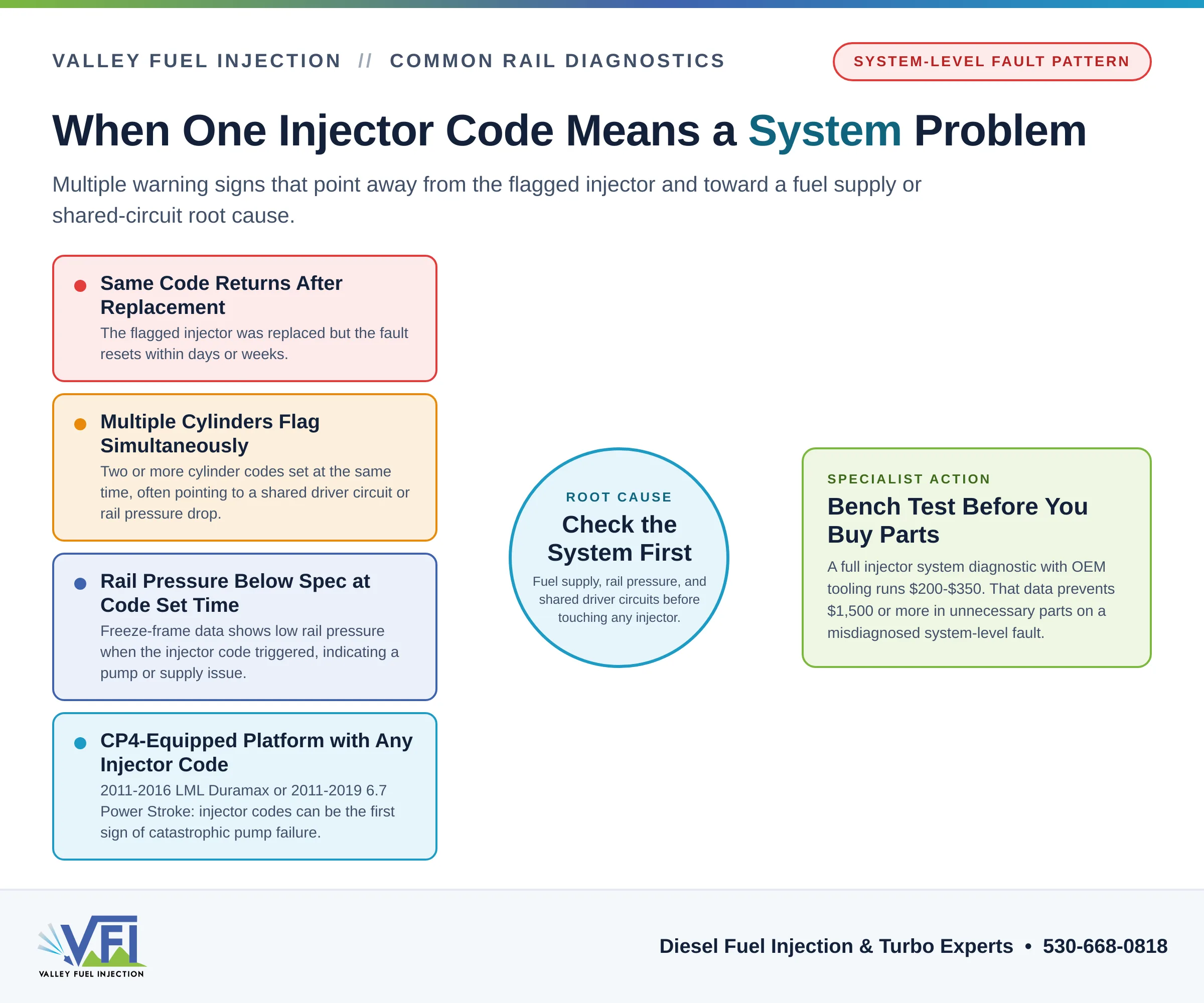
Before chasing any injector code, pull the full freeze-frame data and look at rail pressure at the moment the code set. If rail pressure was below spec when the code triggered, start with the fuel supply system, lift pump, filter, high-pressure pump, and pressure regulator, before touching the injectors.
How to Confirm an Injector Code Before You Buy Parts
Fault codes get you to the right neighborhood; live data and a bench test get you to the right house.
The next stop is balance rates, the per-cylinder fuel corrections the ECM is making, and our guide to Duramax injector balance rates explains what the numbers mean and when to act on them.
Reading those corrections, running a cylinder cut-out test or entering a new injector’s trim code takes factory-level software, which is why generic scanners fall short on modern diesels.
Bench testing settles it. Off the engine, on a calibrated common rail test bench, each injector is measured for delivery at several test points, return (leak-off) flow, response and spray pattern. That tells you not just whether an injector is bad, but how it is bad, and whether it can be rebuilt or needs replacing. Our post on how common rail injectors are tested walks through what the bench measures and what the data means.
You do not have to be near Woodland to get that data. Pull the injectors and ship them in for common rail injector testing: you get real numbers on every injector, so you only rebuild or replace the ones that failed. Bench testing typically runs $50–$100 per injector, far less than a set of injectors you did not need. Our mail-in rebuild service page covers how shipping in from out of state works.
When Fault Codes Should Send You to a Specialist Instead of a Parts Store
Some injector code situations are straightforward. Others are a sign that you need a certified injection specialist, not a replacement part off the shelf.
Go to a specialist when:
- The same injector code returns after replacement. This almost always means the code was pointing at a symptom, not the cause.
- Multiple cylinders are flagging at the same time. Simultaneous multi-cylinder codes usually indicate a system-level problem: rail pressure, fuel supply, or a shared driver circuit.
- You have a rail pressure code alongside injector codes. The injection pump or fuel supply system needs to be evaluated before the injectors.
- The engine is a high-stakes application: fleet vehicle, agricultural equipment in-season, or a truck that cannot be down for a repeat repair.
- You’re on a CP4-equipped truck, such as the 2011–2016 LML Duramax or the 6.7 Power Stroke. A failing CP4 can send metal through the whole fuel system, and GM’s own bulletin for the LML tells techs to check the pump’s pressure regulator for metal debris before a new pump goes in. Put new injectors into a contaminated system and they fail too; a full fuel-system replacement typically runs $10,000–$18,000 or more.
- The injectors are common rail units with IQA codes. Replacement requires programming, and not every shop has the tooling to do it correctly.
The parts-store route makes sense for simple electrical faults with a clear wiring diagnosis, or when a bench test has already confirmed a specific injector is out of spec. It does not make sense as a first response to a code you don’t fully understand.
For fleet managers running mixed equipment, our diesel engine maintenance resources cover how to build a diagnostic protocol that catches injector issues before they become code-generating failures. And if you’re running Kubota equipment, the Kubota injector maintenance guide covers the Tier 4 common rail specifics that apply to that platform.
It’s also worth understanding the difference between cleaning and replacement before you commit to either. Our post on diesel injector cleaning: DIY vs. professional service covers when cleaning is a legitimate option and when it’s just delaying a necessary repair.
Diesel diagnostic scan with live data: typically $150–$300. Injector bench test, per injector: typically $50–$100. Full diagnostic plus bench testing: typically $300–$700. Common rail injector, part only: typically $300–$800 each. Full set installed: typically $3,500–$6,500 on a six-cylinder like the 6.7 Cummins and $5,500–$8,500 on a 6.7 Power Stroke V8. Prices reflect typical California specialty-shop ranges as of 2026. Your actual quote depends on the condition of your specific components, parts availability, and current labor rates. Call VFI at 530-668-0818 for an accurate quote on your job.
The Bottom Line on Reading Diesel Injector Fault Codes
Diesel injector fault codes are a signal from the ECM that something in the fuel delivery system is outside expected parameters. They are not a parts list. Reading them correctly means understanding the difference between circuit faults and performance faults, recognizing when a system-level problem is generating injector-level codes, and using live data and flow testing to confirm what the codes are suggesting before anything gets replaced.
The cost of a proper diagnostic session is almost always less than the cost of replacing the wrong part. And on high-pressure common rail systems, replacing the wrong part can sometimes make things worse, particularly if the real problem is a failing injection pump contaminating the system.
The factory service bulletins back this up. GM, Ford and FCA have all published fixes where codes that named injectors were solved with a harness, a software update or a fuel pump repair. Look up the bulletins for your truck before you buy parts; the chart above is a good place to start.
If you’re in the Sacramento area or Northern California and you’ve got injector codes you can’t get to the bottom of, bring the vehicle to our Woodland shop or call us at (530) 668-0818 to talk through what you’re seeing. Anywhere else in the country, ship your injectors in for mail-in injector testing and get bench data before committing to a repair.
Valley Fuel Injection & Turbo is a Bosch Authorized Service dealer that has tested and rebuilt diesel fuel injection since 1993, on common rail, HEUI, and mechanical systems. We have the test benches and the experience to tell you exactly what your injectors are doing, not just what the code says.
Call us at 530-668-0818, schedule a diagnostic, or visit us at 1243 E Beamer St, Suite C, Woodland, CA 95776. We ship remanufactured injectors and accept mail-in units for bench testing nationwide.
Frequently Asked Questions About Diesel Injector Fault Codes
Can a bad injector cause codes on other cylinders?
Yes, indirectly. An injector leaking badly enough to drag rail pressure down pulls pressure away from every cylinder on the rail and can set rail pressure codes. More often, codes on several cylinders come from something they share: a failing driver module (the 7.3 IDM or 6.0 FICM), a chafed injector harness or ECM software. That is why testing all the injectors, not just the one named in the code, is standard practice before any replacement decision.
Does a P0201 code mean the injector is bad?
Not by itself. P0201 means the ECM saw a fault in the cylinder 1 injector circuit, and wiring, connectors, the driver and ECM software can all set it. GM traced LML injector circuit codes to a harness chafed on the EGR valve gasket, and FCA tied P0201 to P0206 on some 2019 Ram 6.7 trucks to a failed fuel pump. Check the circuit and the fuel system before you buy an injector.
Do I need to program a new injector into the ECM?
On most modern common rail engines, yes. Many injectors carry a trim or IQA (Injector Quantity Adjustment) code on the body, and it has to be entered into the ECM for the correct cylinder after installation so the ECM can correct for that injector’s flow. When it is missing, the ECM can set P268A (fuel injector calibration not learned/programmed). Entering the code takes a factory-level scan tool, not a code reader.
How do I know if my injector code is electrical or mechanical?
Start with the code type. A circuit code (P0201 to P0208, or the circuit low and high codes) points to an electrical fault: check wiring, connectors, and the injector’s electrical specs before assuming the injector is bad. On piezo systems like the LML Duramax the ECM drives the injectors at up to 250 volts, so wait at least 5 minutes after key-off before unplugging anything. A contribution or balance code points to a performance issue, which is more likely mechanical (wear, deposits, tip damage), compression or fuel supply. For performance codes you need live data and ideally a bench test to separate a worn injector from a fuel system problem.