
Best Diesel Fuel Filter: Fleetguard vs Donaldson vs Baldwin vs OEM
06/26/2026
DPF Effect on Diesel Injectors: Fleet Guide
06/28/2026
High-Pressure Fuel Rail Failure: Symptoms, Causes, and What It Means for Your Common Rail System
High-pressure fuel rail failure symptoms are frequently misdiagnosed as bad injectors or a failing CP4 pump, which means trucks end up with expensive parts replaced while the actual problem goes untouched. The fuel rail sits at the center of every common rail system, holding pressurized fuel at 20,000–30,000 PSI and distributing it to each injector on demand. When the rail cracks, leaks, or loses its ability to hold pressure, the entire injection event falls apart. Understanding what a failing rail actually looks and feels like is the difference between a targeted repair and a costly parts-swapping exercise.
Fuel rail problems mimic injector and pump failures almost perfectly. Accurate diagnosis requires pressure drop testing, return-flow analysis, and a technician who understands the entire common rail system, not just its individual components.
What Is the High-Pressure Fuel Rail and What Does It Actually Do?
The high-pressure fuel rail is a precision-machined accumulator that stores and distributes high-pressure fuel between the injection pump and the injectors. Think of it as a pressure reservoir. The high-pressure pump (typically a Bosch CP3 or CP4) builds fuel pressure and pushes it into the rail, where it sits at operating pressure until each injector solenoid opens and pulls fuel for injection. The rail smooths out pressure pulses from the pump and ensures every injector sees consistent, stable pressure regardless of engine load or RPM.
Most modern common rail systems include several components mounted directly to or integrated with the rail itself. These include the fuel rail pressure sensor, the pressure limiting valve (also called the pressure relief valve), and the individual feed lines running to each injector. All of these components affect how the rail behaves under load, and a failure in any one of them can look exactly like a rail failure from the outside. That is precisely why proper diagnosis matters so much before any parts are ordered.
For a deeper look at how pressure loss cascades through the whole fuel system, our post on diesel fuel system pressure loss causes and diagnosis covers the full picture from lift pump to injector tip.
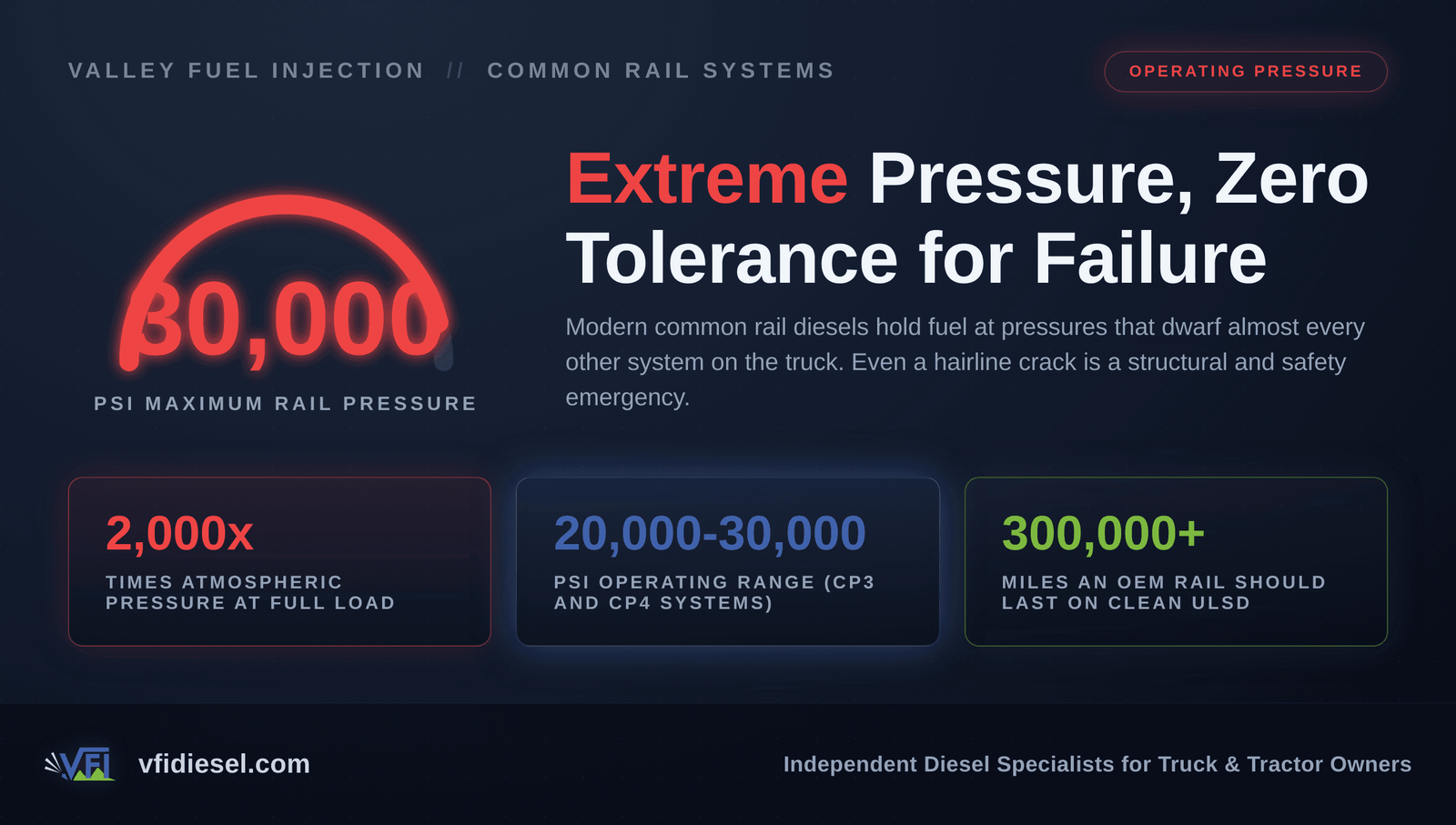
The fuel rail in a modern common rail diesel operates at pressures that can exceed 30,000 PSI at full load. That is roughly 2,000 times atmospheric pressure, which is why even a hairline crack in the rail body is a serious structural and safety concern.
What Are the Symptoms of a Failing High-Pressure Fuel Rail?
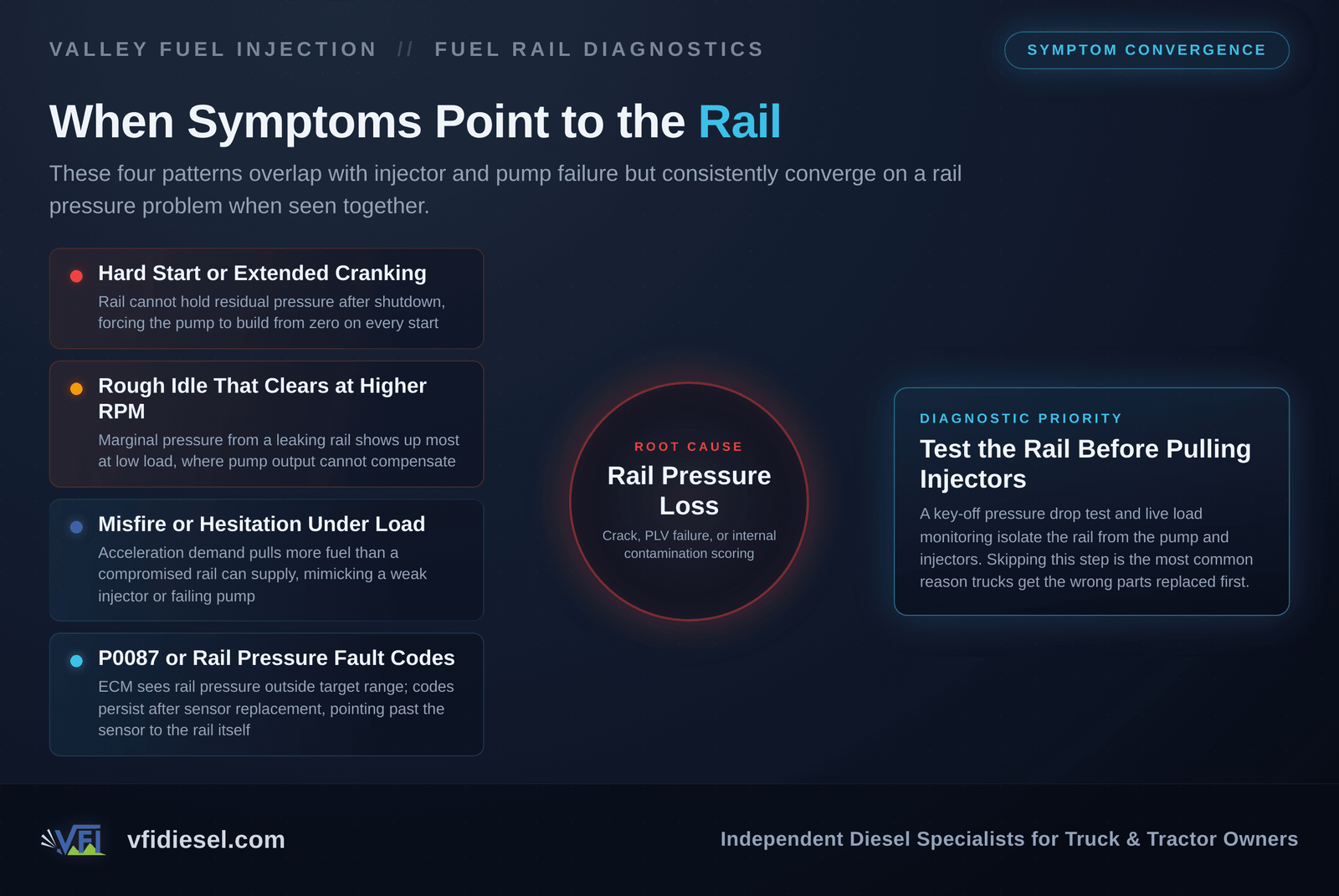
The most common high-pressure fuel rail failure symptoms include hard starting, rough idle, misfires under load, low power, and fuel pressure fault codes that do not resolve after replacing the pressure sensor. These symptoms overlap heavily with injector failure and pump failure, which is exactly why rail problems get misdiagnosed so often.
Here is a breakdown of the specific symptoms to watch for and why each one points toward the rail:
- Hard starting or extended cranking: The rail cannot hold residual pressure after shutdown. When you crank, the pump has to build pressure from zero before injection can begin. On a healthy system, the rail holds pressure for several minutes after the engine stops.
- Rough idle that clears up at higher RPM: At idle, the pump is not working as hard, so marginal pressure from a leaking rail shows up more at low load. As RPM rises, the pump output partially compensates.
- Misfires or hesitation under load: Demand spikes during acceleration pull more fuel from the rail than a compromised rail can supply. The result feels identical to a weak injector or a pump that cannot keep up.
- Fuel pressure fault codes (P0087, P0088, or manufacturer-specific rail pressure codes): These codes indicate the ECM sees rail pressure outside of target range. A P0087 (fuel system too lean / low pressure) is one of the most common codes associated with rail-related failures.
- Visible fuel leak at the rail body or fittings: External leaks are the clearest sign of a rail problem, but they are also the least common symptom of early failure. Most rail failures are internal or at the pressure-limiting valve before any visible leak appears.
- Smoke at startup: Uneven fuel distribution from inconsistent rail pressure can cause rich or lean conditions across individual cylinders, producing white or black smoke on cold starts.
If you are seeing any of these alongside the injector symptoms covered in our post on diesel injector failure warning signs, the rail needs to be ruled out before injectors are pulled and sent out for testing.
A cracked or leaking high-pressure fuel rail is a fire and safety hazard. Diesel fuel spraying at 20,000+ PSI can penetrate skin and cause serious injection injuries. If you suspect an external rail leak, do not run the engine. Have the vehicle towed to a qualified diesel shop immediately.
What Causes High-Pressure Fuel Rail Failure?
Fuel rail failures fall into three primary categories: metal contamination from a failed pump, pressure spikes from a stuck pressure-limiting valve, and manufacturing defects or fatigue cracking from age and heat cycling.
Metal Contamination from a Failing Pump
This is the most destructive cause, and it is directly tied to CP4 pump failures. When a CP4 pump begins to fail, it sheds metal particles into the fuel stream at high pressure. Those particles travel directly into the rail, scoring the internal bore, damaging the pressure sensor seat, and embedding in the injector feed ports. The rail itself may show no external damage while being internally compromised in ways that cause erratic pressure behavior. This is why a CP4 failure is never just a pump replacement job. The rail, injectors, and all fuel lines downstream need to be inspected and often replaced.
The common rail system repair process at our shop always includes a full contamination assessment before any parts are ordered, because replacing a pump into a contaminated rail guarantees a repeat failure.
Pressure Spikes from a Malfunctioning Pressure-Limiting Valve
The pressure-limiting valve (PLV) is a safety device mounted on the rail that opens if pressure exceeds a set threshold. When a PLV sticks open, it bleeds off pressure constantly, causing the system to run lean. When it sticks closed, pressure spikes can exceed the rail’s design limits. Repeated overpressure events cause fatigue cracking at the rail body, fittings, and sensor ports. A PLV that has opened once due to an overpressure event is considered a spent component and should be replaced as part of any rail service.
Manufacturing Defects and Fatigue Cracking
High-cycle fatigue is a real failure mode on high-mileage common rail systems. The rail flexes microscopically with every pressure pulse, thousands of times per minute. Over hundreds of thousands of miles, that cycling can initiate cracks at stress concentration points, particularly around machined ports and fittings. OEM rails are engineered to outlast the engine in most cases, but aftermarket rails with inferior metallurgy can fail much earlier. We have seen aftermarket rails crack at under 50,000 miles on trucks that were previously running OEM hardware without issue.
Water contamination in diesel fuel accelerates rail corrosion from the inside out. California’s B20 biodiesel blends can carry higher moisture content than straight ULSD, which is a contributing factor we see frequently in Northern California trucks. Read more about biodiesel injector damage and California’s fuel quality issues for context on how fuel quality affects the entire high-pressure system.
How Do You Diagnose a Fuel Rail Problem vs. a Bad Injector, Failing Pump, or Pressure Regulator?
Accurate diagnosis requires a combination of live data monitoring, fuel pressure drop testing, and injector return-flow testing. No single test isolates the rail on its own, which is why this work belongs in a shop that understands the whole system.
Here is how a systematic diagnosis works:
| Test | What It Tells You | Rail vs. Other Component |
|---|---|---|
| Rail pressure drop test (key-off) | How fast the system loses pressure after shutdown | Fast drop points to rail crack, PLV, or leaking injector seat |
| Injector return-flow test | How much fuel each injector bleeds back to tank | High return flow on all cylinders suggests rail or pump; high on one cylinder suggests that injector |
| Live rail pressure monitoring under load | Whether pressure tracks commanded target during acceleration | Pressure drop under load with normal pump output points toward rail leak or PLV |
| Pressure sensor substitution test | Whether the sensor is reporting accurately | Rules out false low-pressure codes before condemning the rail |
| Visual inspection with UV dye | Location of any external fuel weeping | Confirms external rail crack or fitting leak when present |
At our shop, a comprehensive common rail diagnostic typically runs $350–$650, depending on system complexity and how many fault codes need to be worked through. That investment almost always saves customers from replacing the wrong component first. Diesel truck owners in the Sacramento area can bring their truck to us for a complete system evaluation before committing to any parts.
The Bosch common rail system technical overview provides useful background on how the rail interacts with the pump and injectors in a properly functioning system, which helps frame what a failure in any one component does to the others.
Fuel rail replacement on a light-duty common rail diesel (6.7 Cummins, Duramax, 6.7 Powerstroke) typically runs $800–$1,800 for the rail itself, with California specialty-shop labor adding $300–$700 on top depending on engine layout and access. A fuel rail pressure sensor replacement typically runs $150–$350 all-in. A pressure-limiting valve replacement typically runs $200–$450. If the rail failure is linked to CP4 contamination, total system repair cost rises significantly, see the section below.
Parts and labor vary by region, engine condition, and current pricing. Call us at 530-668-0818 for an accurate quote.
Can a High-Pressure Fuel Rail Be Repaired, or Does It Always Need Replacement?
In almost every case, a cracked or compromised high-pressure fuel rail needs to be replaced, not repaired. Welding or patching a rail that has cracked under fatigue or contamination damage is not a viable solution at 20,000+ PSI operating pressures. The structural integrity of the rail body is critical, and any repair that alters the base material creates a new stress concentration point that is likely to fail again under pressure cycling.
There are limited situations where a rail can be serviced rather than replaced. If the issue is isolated to a failed pressure sensor, a stuck PLV, or a leaking injector feed fitting, those components can often be replaced individually without replacing the rail body itself. This is why the diagnostic step matters so much. Condemning the entire rail when only the PLV has failed costs the customer several hundred dollars unnecessarily.
When replacement is required, the choice between OEM and aftermarket hardware matters. OEM rails are manufactured to tighter tolerances and use higher-grade steel than most aftermarket alternatives. For trucks that will continue working hard, OEM or OEM-equivalent rails from a certified supplier like Bosch are worth the premium. Our Bosch-certified diesel fuel injection service includes access to genuine Bosch replacement components for common rail applications.
Any time a fuel rail is replaced due to contamination-related damage, the injector feed lines and return lines should be inspected and replaced if there is any sign of scoring or debris. Leaving contaminated lines in place after a rail replacement is a common shortcut that leads to repeat failures within months.
Why Is Fuel Rail Failure Often a Downstream Symptom of a Bigger Problem?
Fuel rail failure is rarely the root cause of a common rail system problem. In most cases, it is a downstream consequence of something that went wrong upstream, usually at the high-pressure pump. This distinction matters enormously for repair planning.
The most common upstream cause in modern diesel trucks is CP4 pump failure. The Bosch CP4.2 pump, used in the 6.7 Powerstroke and LML Duramax, is known to fail catastrophically when fuel lubricity is insufficient. When it fails, metal debris travels at high pressure through the entire fuel system: into the rail, into every injector, and sometimes back into the tank. A rail that has been exposed to CP4 debris may show no external damage but will have internal scoring that prevents it from holding consistent pressure.
Replacing the rail without addressing the pump failure, cleaning the tank, flushing the lines, and inspecting the injectors is a partial repair that will fail again.

The diesel fuel injection pump rebuild cost guide covers what a complete system repair looks like when pump failure has spread contamination downstream.
According to SAE International research on common rail injection system failures, contamination-driven failures account for a significant portion of common rail warranty claims, and incomplete repairs that leave contaminated components in place are a leading cause of repeat failures within the same service interval.
The second most common upstream cause is fuel quality. Low-lubricity ULSD, water contamination, and biodiesel blends with poor stability all accelerate wear throughout the high-pressure circuit. The rail, being the component that holds maximum pressure continuously, shows the effects of poor fuel quality earlier than most other components. If you are in Northern California and running B20 blends, this is a real concern worth discussing with a qualified diesel technician before symptoms appear.
The California Air Resources Board maintains current information on California diesel fuel standards, including lubricity requirements and biodiesel blend regulations, which directly affect how your common rail system wears over time.
Fleet managers and diesel shops in the Reno and Northern Nevada area can reach us at our Reno service area page or call directly. We also accept mail-in injectors, rails, and pumps for bench testing and remanufacturing from shops across the country.
When fuel rail failure is tied to CP4 contamination, repair costs escalate quickly. A moderate contamination event covering the pump, rail, and injectors on a 6.7 Powerstroke or LML Duramax typically runs $7,500–$11,000 at a California specialty shop. Full system contamination including tank cleaning, new lines, and all injectors typically runs $10,000–$15,000+. A preventative CP3 conversion before CP4 failure occurs typically runs $3,000–$5,000 and eliminates the catastrophic failure risk entirely. Prices reflect typical California specialty-shop ranges as of 2026. Your actual quote depends on the condition of your specific components, parts availability, and current labor rates. Call VFI at 530-668-0818 for an accurate quote on your job.
If you are working through a common rail diagnosis and want to understand how injector condition fits into the picture, our guide on diesel fuel injector cleaning and professional service explains what bench testing actually reveals about injector condition alongside rail pressure data.
The EPA’s diesel fuel standards and rulemakings page provides regulatory context on ULSD lubricity requirements, which are directly relevant to understanding why CP4 failures happen at higher rates in certain fuel markets.
Ready for a Real Common Rail Diagnosis?
If your diesel is showing any of the symptoms above, the worst thing you can do is start replacing parts without a proper diagnosis. At Valley Fuel Injection, we have been diagnosing and repairing common rail systems since before most shops knew what a CP4 was. We are one of the few Bosch-certified shops in Northern California with the equipment and experience to test the rail, pump, and injectors as a complete system rather than guessing at individual components.
Call us at 530-668-0818 or schedule a diagnostic at our shop at 1243 E Beamer St, Suite C, Woodland, CA 95776. We also ship remanufactured rails, injectors, and pumps nationwide and accept mail-in components for bench testing and rebuilding. Visit our diesel fuel injection services page to see the full scope of what we do.
Frequently Asked Questions About High-Pressure Fuel Rail Failure
How do I know if my fuel rail pressure sensor is bad vs. the rail itself?
A bad rail pressure sensor typically throws a specific fault code (often P0192 or P0193) and produces inconsistent pressure readings that do not match actual fuel demand. The rail itself failing usually causes pressure drop that shows up across multiple tests, including the key-off pressure decay test and live load monitoring. A qualified technician can substitute a known-good sensor to rule out sensor error before condemning the rail. At our shop, this is one of the first steps in any common rail pressure diagnostic.
Can a bad fuel rail cause a no-start condition?
Yes. If the rail cannot hold residual pressure after shutdown, or if a crack prevents the system from building sufficient pressure during cranking, the engine may crank without starting. This is more common in cold weather, when fuel viscosity is higher and the pump has to work harder to build pressure quickly. A no-start with normal cranking speed and no obvious electrical faults should always include a rail pressure test as part of the diagnostic process.
How long does a high-pressure fuel rail last?
On a properly maintained diesel running clean, high-quality ULSD, an OEM fuel rail should last the life of the engine, typically 300,000 miles or more. Premature failures are almost always linked to contamination from a failing pump, poor fuel quality, or the use of low-grade aftermarket replacement rails. Trucks running biodiesel blends or operating in areas with variable fuel quality may see accelerated wear at the rail sensor ports and fittings.
Is a fuel rail replacement covered under any warranty?
On newer trucks, fuel rail failures caused by a manufacturing defect may fall under the powertrain warranty. CP4-related failures have been the subject of class-action litigation and extended warranty coverage from some manufacturers. If your truck is within the original warranty period or has been subject to a technical service bulletin related to fuel system contamination, it is worth checking with your dealer before paying out of pocket. A qualified diesel shop can document the failure mode in a way that supports a warranty or legal claim if applicable.
What is the pressure-limiting valve and should I replace it with the rail?
The pressure-limiting valve is a safety device mounted on the rail that opens if system pressure exceeds a set threshold, typically around 1,800–2,200 bar depending on the application. Once a PLV has opened due to an overpressure event, it is considered a spent component because the internal spring and seat are no longer calibrated to the original spec. Any time a rail is replaced or a high-pressure system event has occurred, the PLV should be replaced as a matter of course. The cost is modest, typically included in the rail replacement job, and skipping it is a common cause of repeat pressure-related faults.
Related guides from Valley Fuel Injection
- Common Rail Injector Problems: 6 Signs & Expert Solutions
- Diesel Fuel System Pressure Loss: 9 Causes & Diagnosis
- Diesel Injector Return Flow Test: What It Reveals
Suspect a high-pressure rail or injector problem? Valley Fuel Injection bench-tests common rail injectors and pressure-tests fuel systems to find the real cause. Call 530-668-0818.