
Diesel Engine Blue Smoke: Causes & Diagnosis
06/25/2026
High-Pressure Fuel Rail Failure: Symptoms & Causes
06/27/2026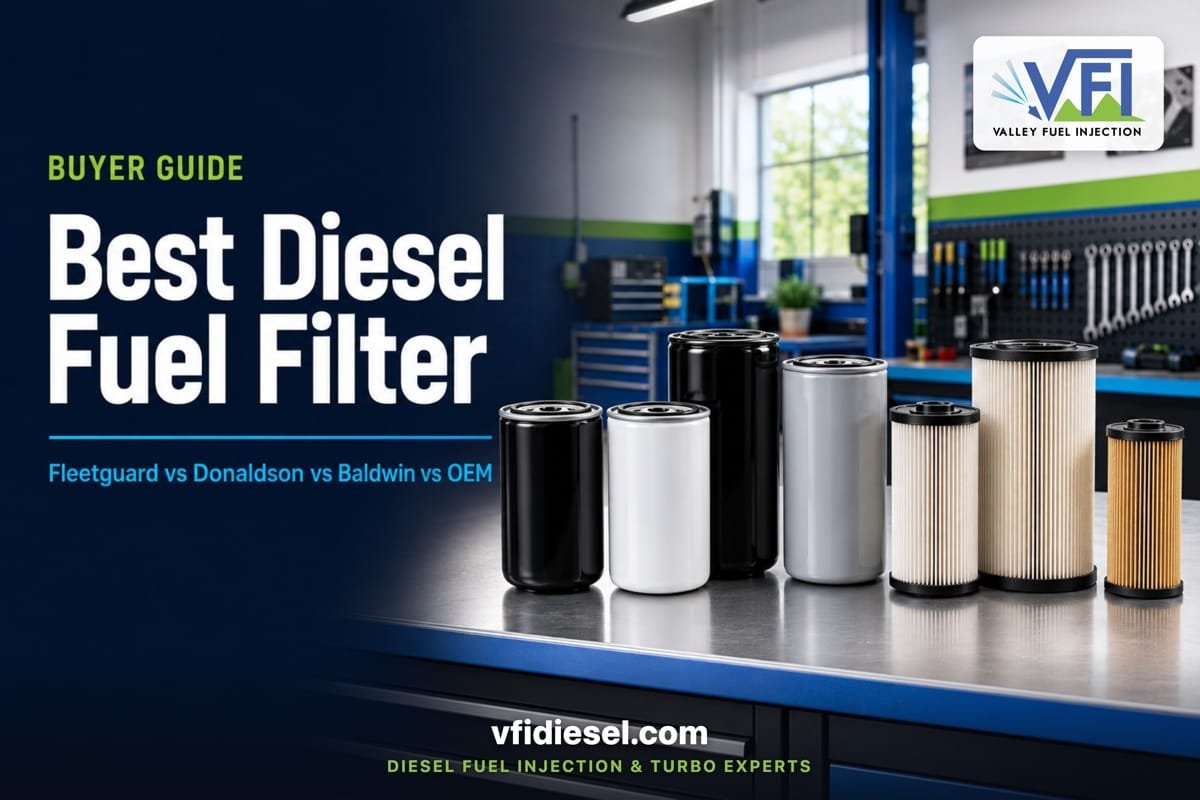
Diesel Fuel Filter Showdown: Fleetguard vs Donaldson vs Baldwin vs OEM
The best diesel fuel filter for your truck or equipment is the one that actually matches the contamination tolerance of your injection system, and most owners have no idea how tight that margin is. We see the downstream consequences every week on our test bench at Valley Fuel Injection. A common rail injector that failed at 80,000 miles because of particle contamination. A VP44 pump with scoring that traces back to a bargain-bin filter that never should have been on the shelf. Choosing between Fleetguard, Donaldson, Baldwin, and OEM is not just a parts decision. It is a decision about how long your injection system survives.
Common rail injection systems require fuel filtered to 2 microns absolute or tighter. Running a filter rated at 10 microns or higher on a modern high-pressure system is not a cost-saving move, it is a slow-motion injector replacement schedule. Fleetguard, Donaldson, and Baldwin all make filters that meet the spec when you buy the right part number. OEM filters are worth the premium on platforms where contamination history is severe. The brand matters less than the micron rating and your change interval.
Why Does Diesel Fuel Filtration Matter More Than Most Owners Realize?
Diesel fuel filtration is the last line of defense between whatever is in your tank and components machined to tolerances measured in microns. Modern common rail injectors operate at pressures ranging from 23,000 to over 30,000 PSI. At those pressures, a particle as small as 4–6 microns, roughly one-tenth the diameter of a human hair, can cause abrasive wear on injector nozzle seats, needle valves, and high-pressure pump internals.
Older mechanical injection systems are more tolerant, but not immune. A Bosch P7100 inline pump or a Stanadyne DB4 rotary pump still has precision-fit plungers and barrels that wear faster when the fuel supply carries fine particulate. The difference is that a mechanical pump can degrade gradually over years, while a common rail CP4 pump can fail catastrophically in a single tank of contaminated fuel, sending metal debris through the entire high-pressure circuit.
Fuel quality in California adds another layer of concern. As we covered in our post on biodiesel injector damage and California’s fuel situation, the biodiesel blends mandated at the pump introduce microbial growth, water entrainment, and accelerated filter plugging that older filter change intervals simply were not designed around. Your filter is working harder than it was ten years ago, on fuel that is harder on the system than it used to be.
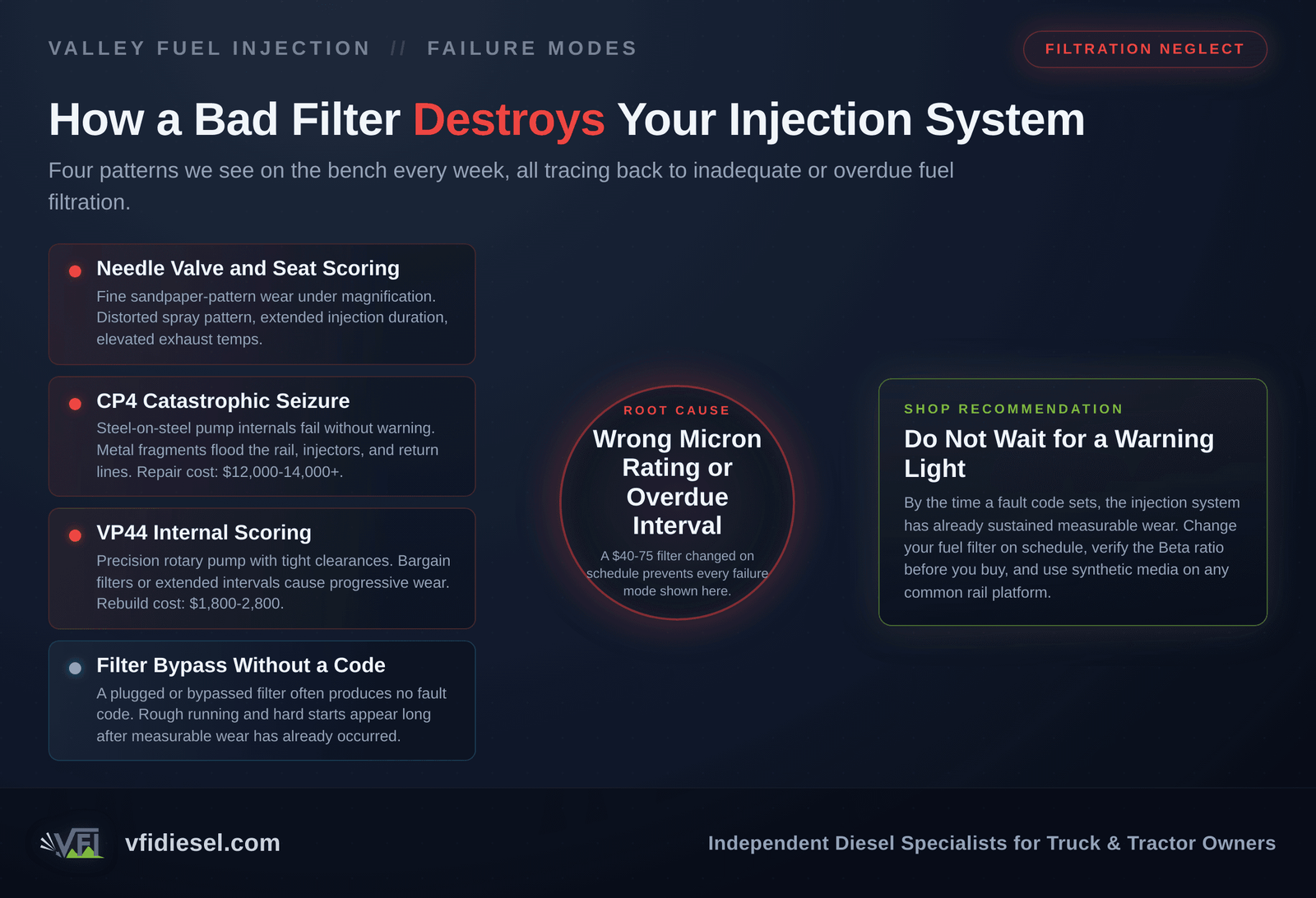
A plugged or bypassed fuel filter does not always trigger a check engine light. Many trucks will run rough, lose power, or develop hard-start symptoms long before a fault code appears. By the time a code sets, the injection system may already have sustained measurable wear. Do not wait for a warning light to change your fuel filter.
What Micron Rating Do You Actually Need for Common Rail vs. Older Mechanical Injection Systems?
The micron rating you need depends entirely on your injection system architecture, and this is where a lot of owners get into trouble by buying a filter based on price or availability rather than specification.
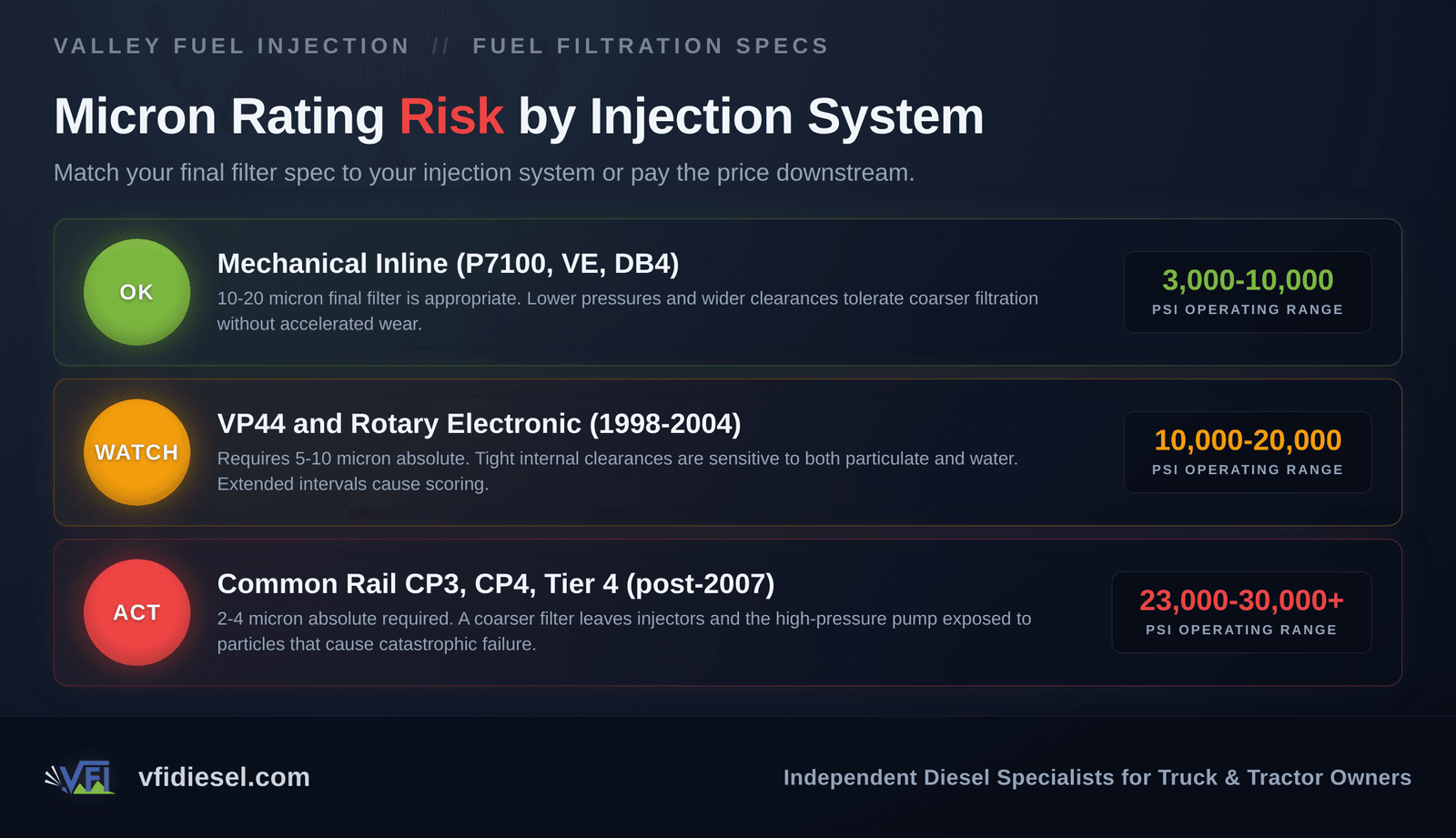
For common rail systems, which includes the 6.7 Cummins, 6.6 Duramax LML and later, 6.7 Powerstroke, and virtually every Tier 4 agricultural and construction diesel built after 2010, the fuel system OEM specifications typically call for primary filtration at 10–30 microns (to catch larger particles and protect the lift pump) and secondary/final filtration at 2–4 microns absolute. The secondary filter is the critical one. It is the last filter before fuel enters the high-pressure pump and injectors.
For older mechanical systems, the tolerance is wider but still real. A Cummins 5.9 12-valve with a P7100, a 7.3 Powerstroke IDI, or a tractor running a Bosch VE pump will typically tolerate filtration in the 10–20 micron range without accelerated wear. These systems run at much lower pressures, typically 3,000–10,000 PSI, and the clearances between moving parts are larger. That said, running the finest filtration you can without excessive restriction is never the wrong call.
| Injection System Type | Operating Pressure | Recommended Final Filter | Bypass Risk |
|---|---|---|---|
| Common Rail (CP3/CP4, post-2007) | 23,000–30,000+ PSI | 2–4 micron absolute | Catastrophic (CP4 debris flood) |
| VP44 / Rotary Electronic (1998–2004) | 10,000–20,000 PSI | 5–10 micron absolute | High (pump scoring, premature failure) |
| Mechanical Inline P-pump (pre-1998) | 3,000–10,000 PSI | 10–20 micron | Moderate (gradual wear) |
| HEUI (7.3/6.0 Powerstroke) | 500–3,000 PSI fuel side | 10–15 micron | Moderate (injector O-ring and spool wear) |
| Kubota/Yanmar Tier 4 (2012+) | 20,000–28,000 PSI | 2–4 micron absolute | High (same as automotive common rail) |
Understanding these specs is step one. The next step is knowing whether the filter you are buying actually hits that number, and that is where the brand comparison gets interesting.
How Do Fleetguard, Donaldson, and Baldwin Filters Compare on Filtration Efficiency and Build Quality?
All three of these brands make filters that can legitimately protect a common rail injection system, but they are not identical products, and the differences matter depending on your application and operating environment.
Fleetguard (Cummins Filtration)
Fleetguard is the filtration division of Cummins, and their fuel filters are the OEM specification on every Cummins-powered truck and a large portion of agricultural equipment. Their FS series (fuel/water separator) and FF series (fuel filter) products are tested to ISO 16889 standards and published with Beta ratio efficiency ratings. For common rail Cummins applications, Fleetguard’s FS1006 and FF5052 are among the most tested filters in the industry with documented 2-micron absolute efficiency at Beta 200 or higher.
Build quality on Fleetguard is consistently high. The media is synthetic blend in their premium line, the end caps are crimped and sealed properly, and the water separation efficiency on their FS-series filters is among the best in the aftermarket. If you are running a Cummins engine, from a 5.9 to a 6.7 to an ISX: Fleetguard is the filter that Cummins engineers used when they designed the fuel system. That matters.
The downside is availability and price. Fleetguard filters are widely stocked at truck stops and parts houses, but the premium synthetic media versions can run $40–$75 per filter at retail. For fleets changing filters every 15,000 miles, that adds up.
Donaldson
Donaldson is arguably the most technically rigorous filtration manufacturer in the heavy-duty segment. Their Blue series fuel filters use what they call Synteq XP media, which is a synthetic layered media designed for higher dirt-holding capacity without sacrificing efficiency. Donaldson publishes detailed filtration efficiency data and their filters are used as OEM specification on a significant number of construction and agricultural equipment platforms including Caterpillar, John Deere, and Komatsu applications.
Where Donaldson stands out is in heavy-duty and off-highway applications. If you are running a Cat 3406, a Volvo D13, a John Deere PowerTech, or any Tier 4 construction machine, Donaldson is often the filter the OEM specifies or recommends as a direct equivalent. Their water separation performance is excellent, and the filter housings are built to withstand the vibration and temperature cycling of equipment that works harder than a pickup truck.
For light-duty diesel pickup applications, Donaldson makes solid products but is less commonly stocked at local parts stores. You may need to order online or through a truck parts supplier, which is a practical consideration for fleet managers who need same-day availability.

Baldwin Filters
Baldwin is the most widely distributed of the three brands and is a common choice for independent shops and fleet maintenance programs. Their BF series fuel filters cover an enormous range of applications and the cross-reference catalog is one of the most comprehensive in the industry. For shops and fleet managers who need one supplier that can cover everything from a Kubota tractor to a Class 8 Kenworth, Baldwin is a practical solution.
Filtration efficiency on Baldwin’s standard line is adequate for most mechanical and HEUI applications, but their premium Stratapore media filters are what you want for common rail systems. The standard cellulose-media Baldwin filters are fine for older mechanical injection systems but should not be used as the final filter on a common rail truck. This is a distinction that matters and one that gets missed when someone grabs a filter off the shelf based on the part number cross-reference alone without checking the media type.
Baldwin’s water separation performance in their standard line is good but not quite at the level of Fleetguard’s FS series. For applications where water contamination is a regular concern, fuel tanks that see condensation, equipment stored outdoors, or California B20 biodiesel blends, we lean toward Fleetguard or Donaldson for the separator element.
Always verify the Beta ratio on any fuel filter before installing it on a common rail system. A Beta ratio of B2(c) ≥ 200 means the filter removes 99.5% of particles 2 microns and larger. A filter rated at Beta 10 at 10 microns sounds fine but leaves your injectors exposed to the particle sizes that cause the most wear in high-pressure common rail systems. The filter brand is secondary to this number. Ask your parts supplier for the spec sheet, if they cannot produce one, choose a different filter.
When Is an OEM Filter Worth the Premium Over an Aftermarket Option?
OEM filters are worth the premium in specific situations, and understanding those situations saves you money without compromising your injection system.
The clearest case for OEM is a platform with a known contamination sensitivity history. The 6.7 Powerstroke with its CP4.2 high-pressure pump is the most obvious example. Ford specifies a dual-filter system precisely because the CP4.2 has essentially zero tolerance for contamination. Running a non-OEM filter on that truck is a risk that is hard to justify given the cost of a CP4 failure. A full fuel-system replacement after a catastrophic CP4 failure typically runs $10,000–$18,000 or more. The OEM Ford filter costs more than a Baldwin equivalent. That math is not complicated.
The LB7 Duramax is another case where OEM or Fleetguard-equivalent filtration is not optional. GM’s original fuel filter spec on the LB7 was inadequate, and early LB7 injector failures were partly attributed to insufficient filtration. GM revised the spec, and running anything less than the updated specification on an LB7 is asking for a repeat of that failure. A set of eight LB7 injectors installed at a California specialty shop typically runs $5,500–$9,500. The OEM filter costs a fraction of that.
For Kubota and Yanmar equipment, OEM filters are worth serious consideration because the filter housing geometry and bypass valve calibration are often specific to the engine’s fuel delivery architecture. As we note in our Kubota injector maintenance guide, using non-OEM filters on Tier 4 Kubota engines has caused bypass valve issues that allowed unfiltered fuel to reach the injection pump. Our Kubota parts and service team stocks OEM Kubota filters specifically because the risk of a non-OEM fitment issue on these engines is real.
For a well-maintained 6.7 Cummins or a 6.6 Duramax LBZ/LMM, a quality Fleetguard or Donaldson filter at the correct specification is a legitimate OEM-equivalent choice that will not compromise the injection system. Save the OEM premium for platforms where the consequences of a filtration failure are catastrophic.
A single fuel filter service at a California specialty diesel shop typically runs $200–$550 all-in depending on the platform, number of filters, and whether a water separator drain and system prime are included. OEM filter parts run $55–$85 vs. $25–$45 for quality aftermarket on most light-duty platforms. Compare that to a common rail injector replacement at $600–$1,200 per injector, or a full CP4 system failure at $10,000–$18,000+, and the cost of running the right filter is essentially zero. Parts and labor vary by region, engine condition, and current pricing, call us at 530-668-0818 for an accurate quote.
What Happens to Injectors and Pumps When You Run an Inadequate Filter: Real Shop Examples?
We see the results of inadequate filtration on our bench regularly, and the patterns are consistent enough that we can often identify a filtration history problem before we even ask the customer about their maintenance records.
The most common presentation is a set of common rail injectors with abrasive wear on the needle valve and seat. Under magnification, the scoring pattern on the needle tip looks like fine sandpaper has been dragged across it. The injector still opens and closes, but the spray pattern is distorted and the sealing surface no longer holds pressure properly. The result is extended injection duration, elevated exhaust temperatures, and eventually a balance rate that is so far off that the ECM sets a misfire code. When we ask the owner what filter they were running, the answer is usually a discount-store house brand or a filter that was changed at 30,000-mile intervals on a truck that should have been serviced every 10,000–15,000 miles.
CP4 pump failures are the most dramatic example. The CP4.2 used in the 6.7 Powerstroke and LML Duramax runs with steel-on-steel contact lubricated entirely by the fuel itself. When the fuel carries fine metallic or silica particles, either from a marginal filter or from a filter that was left in service too long and began to bypass, the pump internals wear rapidly. In a worst-case failure, the pump seizes and sends metal fragments through the entire high-pressure circuit: the fuel rail, the injectors, the return lines. We have seen trucks where every injector had to be replaced along with the pump, the fuel rail, and the lines. That bill easily exceeds $12,000–$14,000 at California shop rates. You can read more about the mechanics of pump failure and what a rebuild or replacement actually costs in our injection pump rebuild cost guide.
VP44 pumps on the 5.9 24-valve Cummins are another frequent victim of filtration neglect. The VP44 is a precision rotary pump with tight internal clearances, and it is sensitive to both particulate and water contamination. We rebuild VP44 pumps regularly, and the ones that come in with the most severe wear almost always have a history of extended filter intervals or bargain filters. A VP44 rebuild at our shop runs $1,800–$2,800. The filter that could have prevented it costs less than $50.
If a bad or bypassed filter has already let debris reach your pump or injectors, you can send them to us from anywhere in the country through our mail-in pump and injector rebuild service; we inspect them and give you a firm quote before any work is done.
ISO 4406 cleanliness codes are the standard used by injection system manufacturers to specify acceptable fuel cleanliness levels. Most common rail OEMs require fuel at the injector inlet to meet ISO 4406 cleanliness of 16/14/11 or better. At that level, particles larger than 4 microns are controlled to fewer than 1,300 per milliliter of fuel. A filter that does not achieve this spec allows contamination levels that exceed the design tolerance of the injection system, every single mile you drive. The Bosch Diesel Systems engineering documentation details these cleanliness requirements for their common rail components.
We also want to be direct about something that does not get said enough: running a quality fuel additive is not a substitute for proper filtration.
Lubricity additives and injector cleaners have their place, we cover that in detail in our post on what diesel fuel additives actually work, but no additive removes particles from the fuel stream. Filtration and additives serve different functions and both matter.
What Filter Do Bosch-Certified Injection Specialists Recommend for Each Application?
After testing, rebuilding, and remanufacturing injection components from thousands of diesel engines across Northern California and Nevada, here is what we actually recommend at the counter.
For 6.7 Cummins (2007.5 and newer): Fleetguard FS1006 water separator plus FF5052 secondary filter, or the Cummins OEM equivalent. Change interval no longer than 15,000 miles, shorter if you are running B20 biodiesel blends, which are standard at many California pumps. The biodiesel blends accelerate microbial growth in the filter media and reduce effective filter life.
For 6.6 Duramax (LBZ, LMM, LML, L5P): Fleetguard or AC Delco OEM on the LML and L5P (CP4 pump, do not compromise). For LBZ and LMM with the CP3, Fleetguard or Donaldson at the correct micron spec is fine. LB7 owners should run OEM AC Delco or Fleetguard only, given the platform’s documented sensitivity.
For 6.7 Powerstroke (2011 and newer): OEM Ford Motorcraft or Fleetguard equivalent at the correct 2-micron absolute spec. This is a CP4 platform. The dual-filter system Ford specifies exists for a reason. Do not skip the chassis-mounted filter to save time on a service.
For 7.3 and 6.0 Powerstroke (HEUI): Baldwin BF1212 or Fleetguard FS1212 series, these are HEUI systems with lower fuel-side pressure, and the tolerance is wider. A quality 10–15 micron filter changed on schedule is sufficient. Our Bosch injector testing and repair service handles a lot of 6.0 Powerstroke HEUI injectors, and most of the failures we see are oil-system related rather than fuel filtration related, but water contamination from a failed water separator is still a contributing factor we see regularly.
For Kubota and Yanmar Tier 4 equipment: OEM Kubota or Yanmar filters are our first recommendation. If OEM is not available, Donaldson is the preferred aftermarket equivalent for these platforms. We stock both OEM Kubota and Yanmar filters at our shop, see our Yanmar parts and service page for availability.
For older mechanical systems (P7100, Stanadyne DB4, Bosch VE): Baldwin or Fleetguard at 10–20 microns is appropriate. These systems are far more tolerant, and the primary concern shifts from particle contamination to water separation. A good FS-series Fleetguard separator on a mechanical injection truck is excellent insurance, especially in California’s agricultural regions where equipment sits between seasons and fuel tanks accumulate condensation.
If you are unsure which filter specification applies to your engine, the Fleetguard filter lookup tool and the Donaldson filter catalog both allow you to search by engine make and model and will show you the published efficiency ratings for each filter. Cross-referencing those ratings against your OEM fuel system specification is the right way to make this decision.
For fleet managers running mixed equipment across Northern California, we also offer fuel system diagnostic and consultation services at our Woodland shop. If you are managing a fleet in the Sacramento region, our Sacramento-area diesel service page has more information on what we can do for fleet accounts. We also accept mail-in injectors and pumps for bench testing and remanufacturing from customers across the country who need the level of specialized service that most shops cannot provide.
The EPA’s diesel fuel standards documentation provides background on fuel quality requirements that inform filter specification decisions, particularly around sulfur content and biodiesel blending limits that affect filter media compatibility and service life.
If you want to go deeper on keeping your injection system healthy between filter changes, our guide on diesel injector cleaning and when professional service is warranted covers the other side of the maintenance equation.
Prices reflect typical California specialty-shop ranges as of 2026. Your actual quote depends on the condition of your specific components, parts availability, and current labor rates. Call VFI at 530-668-0818 for an accurate quote on your job.
Frequently Asked Questions About Diesel Fuel Filters
How often should I change my diesel fuel filter on a common rail truck?
Most common rail diesel trucks specify a fuel filter change every 10,000–15,000 miles under normal conditions. If you are running California B20 biodiesel blends, operating in dusty environments, or using fuel from tanks that may have water contamination, shorten that interval to 7,500–10,000 miles. Biodiesel blends accelerate microbial growth in filter media and can cut effective filter life significantly. When in doubt, change it sooner, a fuel filter costs far less than the injection system it protects.
Can I use a 10-micron filter on my common rail diesel to save money?
No. A 10-micron filter on a common rail injection system leaves the pump and injectors exposed to the particle sizes that cause the most abrasive wear in high-pressure circuits. Common rail systems require final filtration at 2–4 microns absolute. Using a coarser filter to save $20–$30 on a filter change is a false economy when a single common rail injector replacement runs $600–$1,200 and a full CP4 failure can cost $10,000–$18,000 or more to remediate.
Is there a meaningful difference between Fleetguard, Donaldson, and Baldwin on a day-to-day basis?
For most applications, all three brands make filters that will protect your injection system properly when you buy the correct part number at the correct micron specification. The practical differences come down to media type (synthetic vs. cellulose), water separation efficiency, and application coverage. Fleetguard is the strongest choice for Cummins-powered trucks. Donaldson is preferred for heavy-duty and off-highway equipment. Baldwin offers the widest parts-store availability. Where the brands diverge is in their premium vs. standard lines, always verify that you are buying a synthetic media filter rated to the correct Beta ratio for your injection system.
What is the difference between a primary and secondary fuel filter on a diesel truck?
The primary filter (often combined with a water separator) is the first filter in the fuel circuit, typically between the tank and the lift pump. It catches larger particles and separates water before fuel reaches the high-pressure components. The secondary filter is the final filter before the high-pressure pump and injectors, and it does the precision work at 2–4 microns on common rail systems. Both filters matter. Neglecting the primary allows water and large particles to load the secondary filter faster. Neglecting the secondary leaves the injection system unprotected against fine contamination.
Does Valley Fuel Injection sell diesel fuel filters?
Yes. We stock Fleetguard, OEM Kubota, OEM Yanmar, and select Donaldson filters at our Woodland, CA shop. We also carry fuel system components for Bosch, Delphi, and Alliant Power applications. For customers outside Northern California, we ship parts nationwide. Call us at 530-668-0818 or visit our diesel fuel injection services page to learn more about what we carry.
Questions About Your Diesel Fuel System?
We test, rebuild, and remanufacture diesel injection components every day. If you are not sure whether your filtration setup is protecting your injection system, or if you are already seeing symptoms of injector or pump wear, bring it to us. Call 530-668-0818 or schedule a diagnostic at our shop at 1243 E Beamer St, Suite C, Woodland, CA 95776. We also ship remanufactured injectors, pumps, and parts nationwide and accept mail-in components for bench testing and rebuilding.
Related guides from Valley Fuel Injection
- Diesel Fuel System Pressure Loss: 9 Causes & Diagnosis
- How to Bleed a Diesel Fuel System: Step-by-Step
A quality fuel filter is the cheapest insurance your injection system has. Valley Fuel Injection tests and services diesel injection systems and supplies genuine parts. Call 530-668-0818.