Common Rail Injector Problems: 6 Signs & Expert Solutions
04/13/2026
OEM Diagnostic Software Diesel: Why Generic Scanners Fail
04/16/2026
What Is Biodiesel Injector Damage and Why Is It Happening Now?
Biodiesel injector damage occurs when Fatty Acid Methyl Ester (FAME) biodiesel, the traditional soy or canola-based biodiesel, chemically attacks precision injection components. Unlike renewable diesel (which has a chemical makeup similar to petroleum diesel), FAME biodiesel oxidizes more easily than petroleum diesel, and aged or off-spec biodiesel can attack some seal and metal materials.California’s LCFS regulations give refiners an incentive to blend biodiesel into diesel fuel. Ordinary diesel (ASTM D975) can contain up to 5% biodiesel (B5). That is a fuel spec limit, not a federal cap.How Does Biodiesel Damage Diesel Injection Systems?
Biodiesel can damage injection parts in six main ways. These are the six we look for when parts come into our Woodland facility:1. Oxidation and Gum Formation
FAME biodiesel oxidizes rapidly when exposed to air, heat, and light. This oxidation creates gums, varnishes, and polymers that clog injector nozzles and stick injection components.2. Acid Formation and Metal Etching
As biodiesel oxidizes, it forms organic acids that etch precision-machined surfaces inside injectors and high-pressure pumps. We regularly see acid etching on injector needles, pump pistons, and rail pressure sensors, damage that appears as microscopic pitting that destroys sealing surfaces.3. Deposit Formation on Critical Surfaces
Biodiesel combustion creates different deposit patterns than petroleum diesel. These deposits accumulate on injector tips, inside nozzle holes, and on intake valves. The deposits are often harder and more adhesive than traditional carbon deposits, requiring specialized professional cleaning techniques to remove.4. Water Absorption and Microbial Growth
FAME biodiesel is hygroscopic, it absorbs water from the air. This water promotes microbial growth in fuel tanks and creates emulsions that damage fuel system components. Water also accelerates the oxidation process, creating a cascade of fuel degradation.5. Elastomer and Seal Degradation
Biodiesel swells and degrades rubber seals, O-rings, and gaskets throughout the fuel system. This is particularly problematic in older equipment not designed for biodiesel compatibility. Seal failures lead to external leaks and internal pressure losses that affect injection timing and spray patterns.6. Thermal Breakdown Under High Pressure
Modern common rail systems run at up to 2,000 to 2,700 bar (about 29,000 to 39,000 PSI) depending on the system, and the fuel gets hot as it is pressurized and returned. Heat speeds up oxidation of aged or off-spec biodiesel.What Blend Levels Are Safe for Common Rail Injectors, VP44 Pumps, and Rotary Injection Pumps?
The answer depends heavily on the specific injection system, the age of the seals and elastomers already in the pump, and how well the biodiesel was produced and stored. There is no single universal safe threshold, but there are well-established guidelines based on OEM specifications and what we see on our test bench.
Common Rail Systems (CP3, CP4, Piezo Injectors)
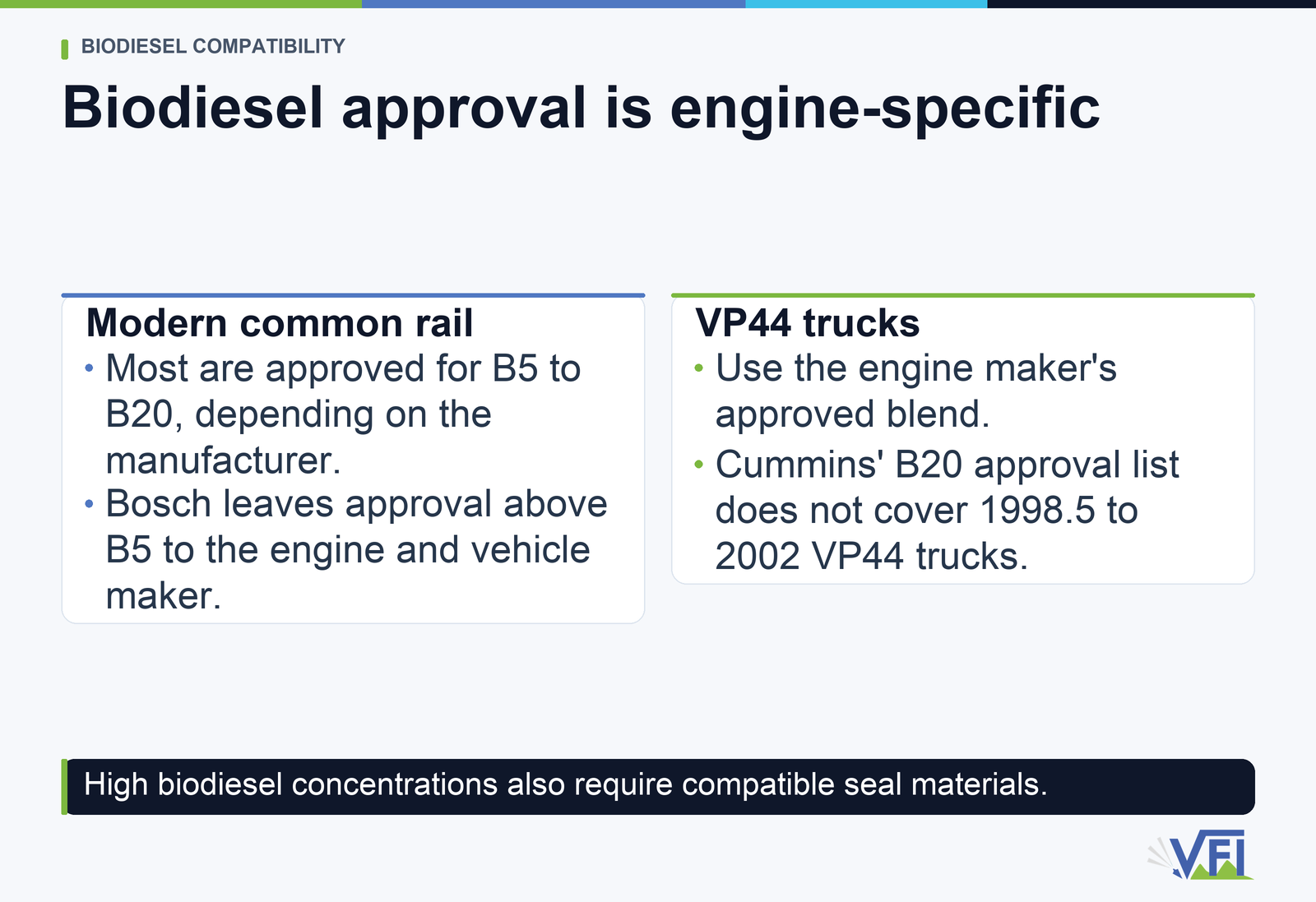
Most modern common rail systems, including the Bosch CP3 used in Cummins and Duramax applications and the CP4.2 used in the 6.7 Powerstroke and LML Duramax, are OEM-approved for B5 to B20 depending on the manufacturer. Bosch leaves biodiesel approval above B5 to the engine and vehicle maker.
The CP4.2 is a different story. Its tighter tolerances and lower internal lubrication make it more sensitive to fuel quality variation, and many technicians and OEM service advisories treat B20 as the practical upper limit for CP4 systems with any caution applied.
Piezo-electric injectors, used in some Duramax and European common rail applications, are particularly sensitive to fuel chemistry changes. Their small control valves are sensitive to deposits and off-spec fuel.
For our customers running common rail trucks in the Sacramento area, our general guidance is: B20 with quality fuel and shortened filter intervals is workable. B50 and above starts introducing real risk, especially for injector tip deposits and seal degradation. B100 in a common rail system not specifically designed and sealed for it is a path to expensive repairs. You can read more about the specific damage patterns we see in the damage mechanisms covered above.
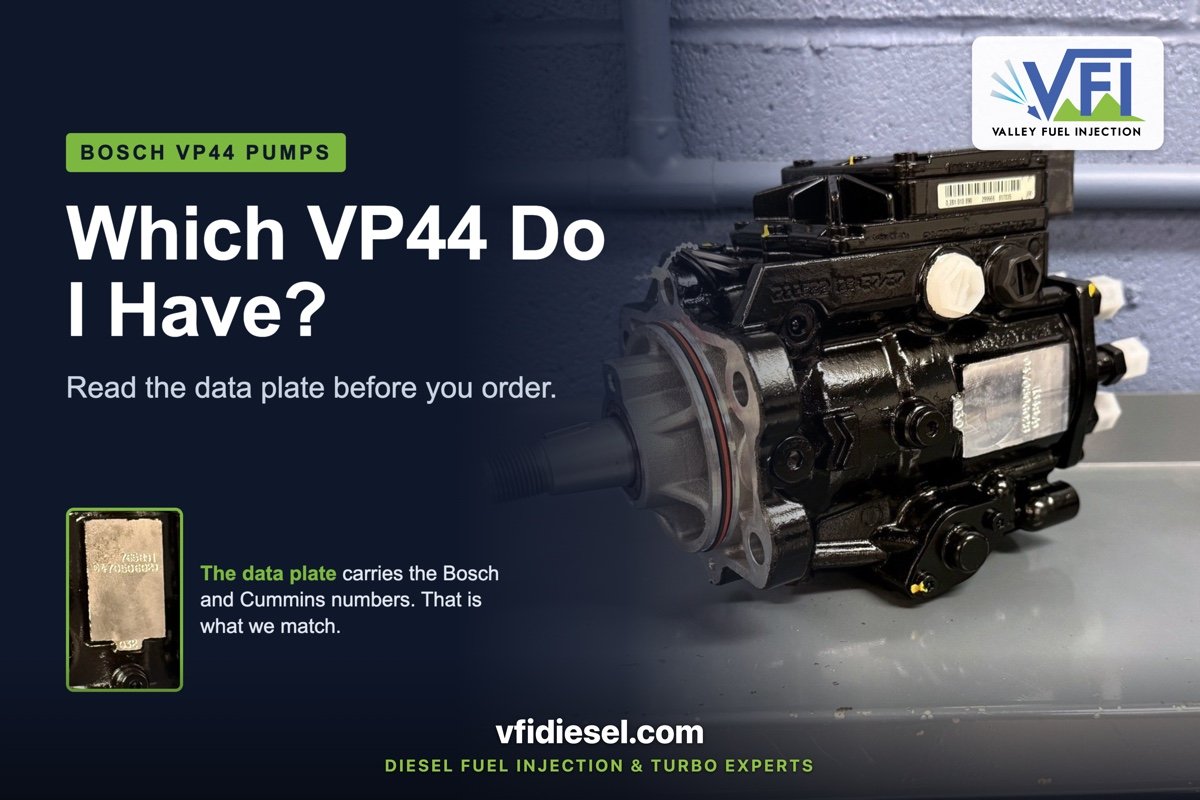
VP44 Electronic Rotary Pumps (98.5–02 Cummins 5.9)
The VP44 is one of the more biodiesel-sensitive pumps we work on. Its internal electronics module (the ECM bolted to the pump body) is vulnerable to heat and moisture, and biodiesel’s hygroscopic nature accelerates moisture intrusion around seals.
Use the engine maker’s approved blend. Cummins’ B20 approval list covers ISB engines from 2007 on, not the 1998.5 to 2002 VP44 trucks. Inspect seals during any pump service. If you’re already dealing with VP44 problems, our Bosch injection pump testing and repair service covers full VP44 bench evaluation.
Mechanical Rotary Pumps (Stanadyne, Bosch VE, CAV/Lucas)
Older mechanical rotary pumps used in agricultural equipment, older pickups, and stationary engines are often cited as more biodiesel-tolerant because their tolerances are less tight than common rail systems. That is partially true, the pressure differentials are lower and the precision requirements less extreme.
However, the seal compatibility issue is just as real. Stanadyne DB2 and DB4 pumps, Bosch VE pumps, and CAV/Lucas DPA units all use elastomers that can be attacked by high-concentration biodiesel. B20 is generally manageable. B100 over extended periods will degrade seals and can cause swelling that affects governor and delivery valve function.
Beyond elastomers, biodiesel oxidation products create lacquer-like deposits on injector needle valves and spray hole edges. Unlike conventional carbon deposits, which tend to be hard and dry, biodiesel deposits can be softer and more adhesive at first, then harden over time. Either way, they alter spray pattern geometry, affect atomization, and reduce injector efficiency. We also see accelerated wear on high-pressure pump internals, particularly plunger and barrel assemblies in CP3 pumps, when biodiesel quality is inconsistent or blend levels exceed what the system was designed for.
What Do Equipment Manufacturers Say About Biodiesel?
Each engine maker sets its own biodiesel limits, and many approve B20 for listed engines. Check your engine’s approval list before you fill up:John Deere permits B20 in its Final Tier 4/Stage IV and Interim Tier 4/Stage III B engines, and B100 in Tier 3/Stage III A and lower-tier engines, subject to its fuel requirements. Kubota approves B20 for listed models and serial ranges. Use its application list and fuel-quality requirements.Seal material: Standard nitrile (NBR) seals swell and soften with high-FAME fuel, and off-spec biodiesel with free methanol or glycerin speeds that up. Viton (FKM) seals resist that swelling, and VFI specifies them for pump rebuilds and injector seal service on biodiesel applications. A full seal service visit typically ranges from $350 to $900 depending on the application and how many components need attention. Call 530-668-0818 to talk to a tech about your pump.
Why Are California Farmers Hit Hardest?
California’s agricultural sector faces unique biodiesel challenges that create perfect conditions for injection system failures:Seasonal Equipment Usage: Tractors, combines, and irrigation pumps often sit idle for months between seasons. Biodiesel degrades rapidly during storage, forming acids and deposits that can damage injection components when equipment is restarted.Older Equipment: Many farm operations use older tractors and equipment with injection systems not designed for biodiesel compatibility. Seals, gaskets, and fuel system materials degrade rapidly when exposed to FAME biodiesel.Remote Locations: Farms often rely on bulk fuel delivery, meaning biodiesel sits in storage tanks for extended periods, accelerating oxidation and degradation.How Can You Protect Your Diesel Injection System?
Biodiesel blends are common in California diesel, but you can take steps to minimize biodiesel injector damage:Choose Your Fuel Carefully
– Seek out petroleum diesel or renewable diesel when possible. Renewable diesel such as Neste MY is a paraffinic fuel with a chemical makeup similar to petroleum diesel. Use it in approved applications that meet the required fuel spec. – Avoid “biodiesel” labeled fuels unless your equipment manufacturer specifically approves them. – Check the pump label: California requires an extra biodiesel label above B5. Blends through B5 need no extra label, so ask your supplier for the blend when you need to know.Implement Fuel Management Practices
– Follow the engine maker’s storage limit. Kubota’s B6 to B20 guide limits storage to one month, and B5 to three months. – Add fuel stabilizers designed for biodiesel blends (not just petroleum diesel stabilizers). – Keep fuel tanks full to minimize air exposure that accelerates oxidation. – Install water separators to remove moisture that biodiesel absorbs from the air.Monitor Your Injection System
Watch for early warning signs of common rail injector problems: – Rough idle or misfiring – Black smoke or excessive emissions – Reduced power or fuel economy – Hard starting, especially after sitting – Unusual engine noises or vibrationIf you notice these symptoms, schedule a diagnostic immediately. Early intervention can often prevent complete injection system failure.Consider System Upgrades
For high-risk applications, consider upgrading vulnerable components: – CP4 to DCR conversion for Ford 6.7L trucks, or CP4 to CP3 conversion for 2011 to 2016 LML Duramax – Biodiesel-compatible seals and gaskets for older equipment – Enhanced filtration systems to remove biodiesel degradation products

How Does Biodiesel Affect Fuel Filter Life, Cold-Start Performance, and Injector Deposits?
Fuel Filter Life
Biodiesel shortens fuel filter life in two ways. First, its solvent action loosens tank and line deposits that have built up during years of petroleum diesel operation. That material hits the filter all at once during a blend transition.
Second, biodiesel’s higher affinity for water means more water reaches the primary filter, and water-saturated filters plug faster. On B20, follow the engine maker’s filter schedule. Kubota, for example, calls for fuel filter changes at half the normal interval on B6 to B20. On B50 and above, filter monitoring should be continuous, not interval-based.
Under California’s Low Carbon Fuel Standard, cardlock and retail diesel in the Central Valley increasingly contains biodiesel blends, sometimes without clear labeling. If your filter life has shortened noticeably without any other obvious cause, biodiesel content in your fuel supply is worth investigating. Our diesel fuel additive guide covers products that can help manage fuel quality, including dispersants that address biodiesel-related deposit issues.
Cold-Start Performance
Biodiesel’s higher cloud point is a real operational concern in Northern California and Nevada, where overnight temperatures in the mountains, high desert, and even the valley floor can drop enough to cause fuel gelling in high-blend tanks. B20 adds meaningful cold-flow risk compared to straight ULSD. B50 and B100 can gel at temperatures that occur routinely in Redding, Reno, or the Sierra foothills from November through March.
Gelled fuel does not just cause no-start conditions. It can force the lift pump to work against excessive restriction, starving the high-pressure pump of adequate supply pressure and causing wear or cavitation damage.
Cold-start injector performance also suffers when fuel viscosity is elevated, the injection system may compensate with longer injection duration, which affects combustion efficiency and can increase white smoke during warm-up. Our post on diesel fuel system seasonal problems covers the flip side of this issue, but the cold-weather concern with biodiesel is equally real.
Injector Deposits
Biodiesel deposit chemistry is different from petroleum diesel deposit chemistry, and that matters for how you address it. Conventional diesel injector deposits respond well to standard detergent additives. Biodiesel-derived deposits, particularly polymerized fatty acid residues on injector tips, can be more resistant to standard detergents and may require more aggressive cleaning protocols.
On the bench, we see biodiesel deposit patterns concentrated around the spray holes and needle seat in ways that are visually distinct from conventional fouling. If you are running biodiesel and notice power loss, rough idle, or increased smoke, injector deposits are a primary suspect worth evaluating before assuming pump failure.
Maintenance Intervals That Change on Biodiesel
Running biodiesel requires a more active maintenance posture across several service categories. These are the specific interval adjustments we recommend to customers at our Woodland shop and to fleet operators throughout Northern California.
Fuel filters: Follow the engine maker’s filter schedule covered above. During any blend transition (switching from straight ULSD to any biodiesel content), inspect the filter at 500 miles or the first opportunity after the transition fill. The tank-cleaning effect can be dramatic and fast.
Water separator inspection: Check the water separator bowl at every fuel stop for the first few weeks on a new biodiesel blend. Biodiesel’s water affinity means water accumulation can happen faster than you expect, particularly in humid conditions or when fuel has been stored in tanks with temperature cycling.
Injector service: Biodiesel deposit accumulation affects spray pattern before it causes obvious power loss. Catching it early is far less expensive than a full injector replacement. A diagnostic fuel system inspection at our shop typically runs $200–$400, which is a small investment compared to a full injector set replacement that can range from $3,500 to $9,000 depending on your engine.
Pump seal inspection: Any time a high-blend biodiesel vehicle comes in for pump service, we inspect all accessible seals and O-rings as a matter of course. We recommend that VP44 owners running B20 or above include a seal inspection with every pump-related service. For common rail CP3 systems, seal condition is worth checking at major service intervals. Our common rail service page covers what a full common rail inspection includes.
Cold-weather fuel management: If you operate in areas where overnight temperatures drop below 40°F, which includes much of Nevada and the NorCal mountains, add a winter cold-flow improver rated for biodiesel blends. Standard ULSD cold-flow additives may not address the higher cloud point of the biodiesel fraction. Consult your additive supplier for a product specifically rated for FAME-containing blends.
Storage and tank management: Biodiesel has a shorter storage life than petroleum diesel, so follow the engine maker’s storage limit listed in the fuel management steps above.
Oxidation stability becomes a real concern for seasonal equipment like agricultural tractors, generators, and construction machines that may sit for extended periods. Use a stabilizer with antioxidant properties if the equipment will sit.
For Kubota applications covered by its B6 to B20 guide, storage past that limit calls for replacing the fuel with mineral diesel and running the engine at least 30 minutes to clear the biodiesel. The U.S. Department of Energy’s Alternative Fuels Data Center has detailed storage guidance for biodiesel blends worth bookmarking.
If you are a fleet manager or equipment owner in the Sacramento area dealing with biodiesel-related maintenance questions, our diesel engine maintenance services page covers how we approach fuel system health across different applications. Call us at 530-668-0818 to discuss your specific situation, biodiesel maintenance is not one-size-fits-all, and a quick conversation can save you from an expensive surprise down the road.
- Fuel system diagnostic inspection: typically $200–$400
- Injector seal / O-ring service (parts + labor): typically $350–$900 per visit
- Fuel filter service (primary + secondary): typically $250–$550
- Lift pump replacement: typically $500–$1,100
- VP44 pump rebuild + R&I labor: typically $2,400–$3,400
- CP3 pump replacement: typically $2,800–$4,500
- Full common rail injector set (6-cylinder): typically $5,500–$9,000 installed
What We’re Seeing at Valley Fuel Injection
As a Bosch-certified diesel injection specialist, we see biodiesel-related damage on the bench. Our injection testing equipment shows patterns like these:– Acid etching on injector needles, microscopic pitting that destroys sealing surfaces – Oxidation deposits in high-pressure pumps, gums and varnishes that stick components – Seal degradation throughout fuel systems, swelling and cracking from biodiesel exposureWe’ve developed specialized cleaning and testing procedures for biodiesel-damaged components, and we stock biodiesel-compatible seals and parts for critical repairs. Our mail-in testing service helps customers nationwide determine if biodiesel damage is affecting their injection systems.The Bottom Line on California’s Biodiesel Crisis
The solution isn’t to abandon environmental goals, but to recognize that renewable diesel, not FAME biodiesel, is chemically close to petroleum diesel and does not carry FAME’s storage and water problems. Until you know your blend, diesel operators must take proactive steps to protect their injection systems from biodiesel damage.If you’re experiencing injection problems that might be related to biodiesel, don’t wait. Sacramento area and Reno operators can bring their equipment to our Woodland facility, or we can test injectors shipped from anywhere in the country. Call us at 530-668-0818 to discuss your specific situation, we’ve seen this damage pattern hundreds of times and know exactly how to diagnose and repair biodiesel-related injection failures.Frequently Asked Questions About Biodiesel Injector Damage
Can biodiesel damage be repaired, or do I need new injectors?
Minor biodiesel damage can often be repaired through professional cleaning and component replacement. However, severe acid etching or deposit formation may require injector replacement. Our testing determines which components can be salvaged.
How can I tell if my fuel contains biodiesel?
California requires an extra biodiesel label above B5, and blends through B5 need no extra label. Look for “B” designations (such as B10 or B20) or ask your fuel supplier for the blend. Renewable diesel is often labeled as “R99” or similar.
Will using fuel additives prevent biodiesel damage?
Quality fuel stabilizers can slow biodiesel degradation but cannot remove every risk. The best protection is avoiding high-biodiesel blends when possible.
Are newer diesel engines more resistant to biodiesel damage?
Actually, newer common rail systems with higher pressures (up to about 29,000 to 39,000 PSI) are often more sensitive to biodiesel damage than older mechanical injection systems. The precision tolerances and extreme pressures accelerate biodiesel degradation.
Can I get warranty coverage for biodiesel-related failures?
Most manufacturers exclude warranty coverage for damage caused by fuels exceeding their specifications. Use the blend your engine maker approves.
Can I run B20 biodiesel in my 6.7 Cummins or Duramax without damaging the injectors?
It depends on the model year. Cummins approves B20 for the 6.7L ISB built from 2007 on, and GM approves B20 for 2011 and newer Duramax engines. GM limits the 2001 to 2010 CP3 Duramax engines (LB7 through LMM) to B5. Check your owner’s manual for your truck’s limit. The key conditions are that the blend meets ASTM D7467 (ASTM D6751 covers the B100 blendstock), you follow the engine maker’s filter schedule, and you monitor for cold-weather gelling if you operate in areas where temperatures drop below 40°F.
Running B20 with off-spec fuel or ignoring filter intervals is where problems develop. If you have a CP4.2-equipped truck (2011 to 2016 LML Duramax or 2011 and newer 6.7 Powerstroke), the CP4’s tighter tolerances make fuel quality even more critical, consult a qualified diesel technician before running biodiesel blends above B5 in a CP4-equipped vehicle.
Does biodiesel actually improve lubricity, and does that help my injection system?
Yes, biodiesel does improve lubricity compared to ultra-low sulfur diesel (ULSD), and that is a genuine benefit for injection system wear. Even B2 blends measurably improve ULSD lubricity, which is why some operators use low-level biodiesel blends specifically as a lubricity additive. The lubricity benefit is real and helps plunger-and-barrel wear in high-pressure pumps.
However, the lubricity benefit does not offset the seal compatibility and oxidation stability risks at higher blend levels. Think of it as a trade-off: low-blend biodiesel gives you a lubricity benefit with minimal downside; high-blend biodiesel gives you more lubricity benefit but introduces seal, deposit, and cold-weather risks that outweigh the gain for most applications.
What should I do if I accidentally ran B100 or high-blend biodiesel in a system not designed for it?
Do not panic, but do act promptly. Drain the fuel tank completely, flush the fuel lines, and replace the fuel filter immediately. Refill with straight ULSD or a low-blend B5 fuel. Inspect the water separator bowl and drain any accumulated water. Then monitor closely over the next several hundred miles for any symptoms of seal swelling, filter plugging, or injector performance issues.
If the vehicle had been running high-blend biodiesel for an extended period before you identified the issue, have a qualified diesel technician perform a fuel system inspection including injector contribution testing and pump pressure evaluation. Catching biodiesel-related seal degradation early is far less costly than waiting for a seal failure to introduce fuel into unintended areas of the engine.