6.7 Cummins vs 6.6 Duramax: Injection Reliability
06/23/2026
Diesel Engine Blue Smoke: Causes & Diagnosis
06/25/2026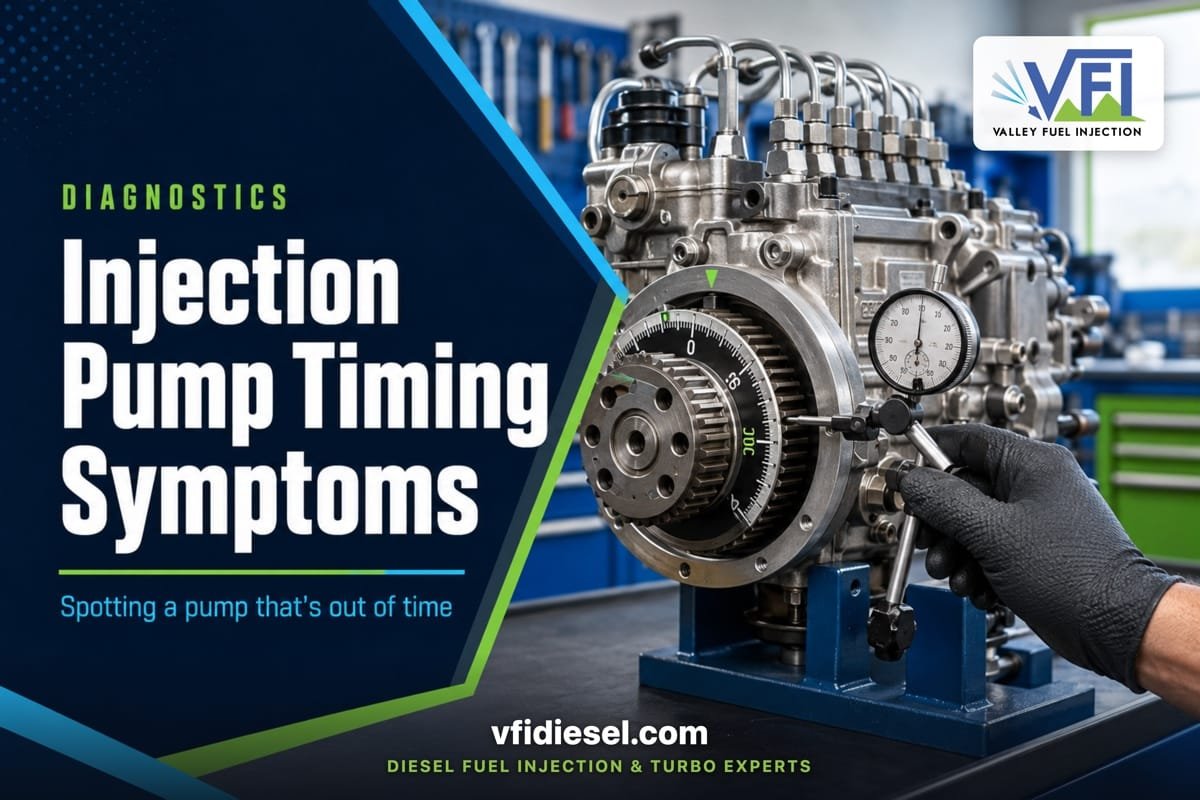
Diesel Injection Pump Timing Symptoms: How to Tell If Your Pump Is Out of Time
Diesel injection pump timing symptoms include hard starting, excessive black or white smoke, a sharp knocking noise under load, poor power output, and elevated exhaust temperatures. These symptoms overlap with a lot of other diesel problems, which is exactly why timing is frequently misdiagnosed. When fuel fires at the wrong moment in the combustion cycle, everything downstream suffers. Whether you’re running a Stanadyne DB4 on an ag tractor, a Bosch VE pump on a 12-valve Cummins, or a modern common rail system, timing errors produce a recognizable pattern once you know what to look for.
Injection pump timing controls when fuel enters the combustion chamber relative to piston position. Even a few degrees of error in either direction produces measurable symptoms, and left uncorrected, timing problems cause real mechanical damage to injectors, pistons, and turbochargers. A certified diesel shop can diagnose and correct timing accurately, often without replacing the pump.
What Does Injection Pump Timing Actually Control in a Diesel Engine?
Injection timing controls the precise crank angle at which fuel is delivered into the combustion chamber. In a diesel engine, there are no spark plugs. Combustion happens because highly compressed air reaches temperatures high enough to ignite diesel fuel on contact. If fuel arrives too early (advanced timing), it fires before the piston reaches top dead center, creating a sharp pressure spike that hammers the piston and rod bearings. If fuel arrives too late (retarded timing), combustion extends into the power stroke and exhaust cycle, producing incomplete burn, black smoke, and heat that spills into the turbocharger and exhaust system.
On mechanical rotary pumps like the Stanadyne DB2, DB4, and Bosch VE, timing is set by the physical relationship between the pump drive gear and the engine’s gear train. A timing advance mechanism inside the pump also adjusts delivery angle based on engine speed and load. On modern common rail systems, the ECM controls injection timing electronically by triggering solenoid or piezo injectors at a calculated crank angle, with feedback from the crankshaft and camshaft position sensors keeping everything synchronized in real time.
Understanding this distinction matters because the failure modes are completely different. A mechanical pump drifts out of time gradually, often due to wear or a slipped drive gear. A common rail system loses timing accuracy suddenly, usually because of a sensor failure, a fuel pressure problem, or injector wear that the ECM can no longer compensate for.

Timing is measured in degrees of crankshaft rotation before top dead center (BTDC). Most light-duty diesel engines run somewhere between 2 and 12 degrees BTDC at idle, with the advance mechanism pushing that number higher under load. Even a 2-degree error from spec is enough to produce noticeable symptoms on a well-tuned engine.
What Are the Most Common Symptoms of Incorrect Diesel Injection Timing?
The symptoms depend on which direction timing has drifted. Advanced and retarded timing produce different patterns, and recognizing that difference narrows the diagnosis considerably.
Symptoms of Advanced Timing (Fuel Too Early)
- Hard metallic knock under load: This is the most distinctive sign of over-advanced timing. The knock is sharp and mechanical, often described as a “diesel clatter” that gets worse as load increases. It differs from the normal diesel combustion noise by its harshness and load-sensitivity.
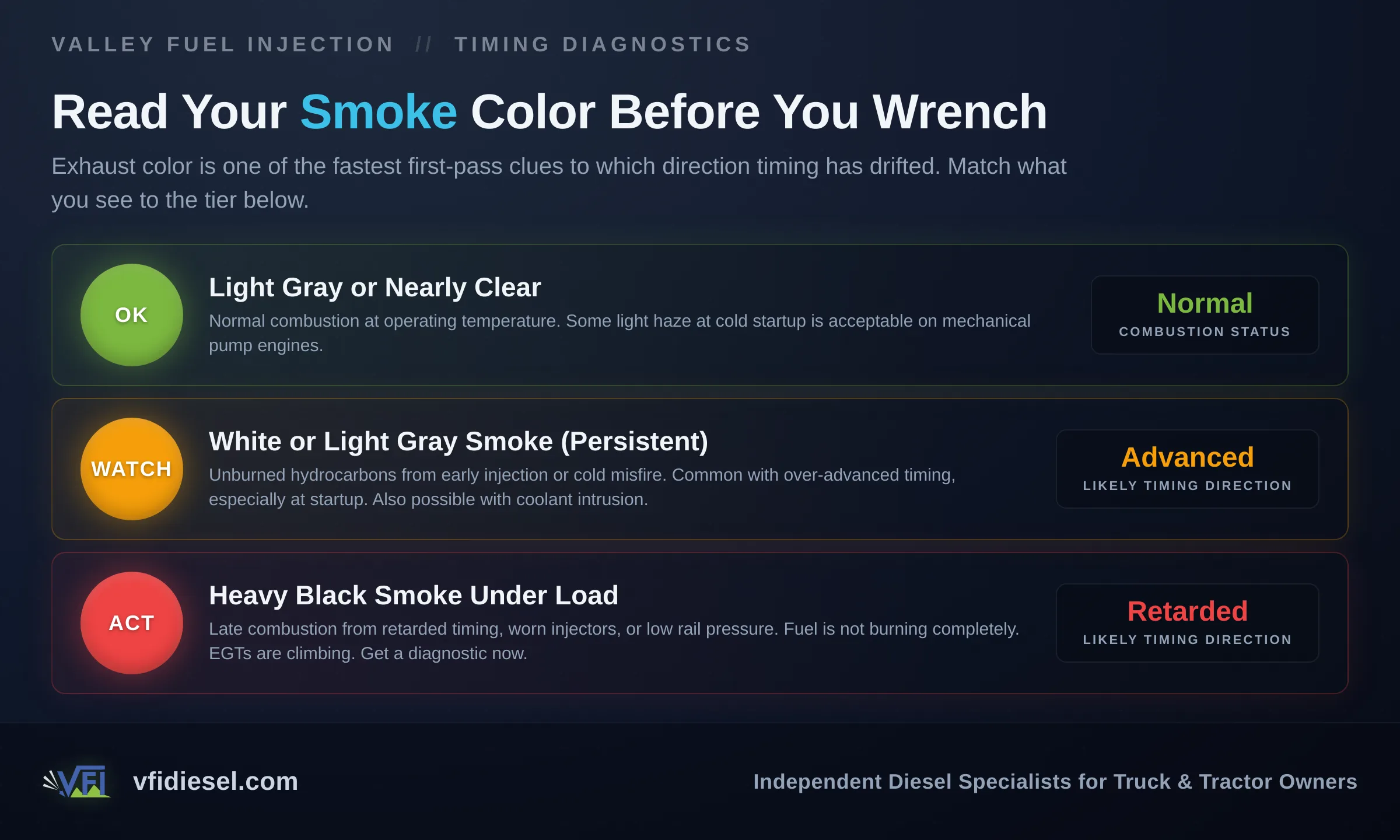
- White or light gray smoke at startup: Fuel injected too early partially misses peak compression, leading to incomplete combustion and unburned hydrocarbons in the exhaust, especially when the engine is cold.
- Rough idle: Over-advanced timing creates uneven cylinder pressure events that show up as a rough, loping idle.
- Elevated coolant temperature: Premature combustion transfers heat into the piston crown and cylinder head rather than converting it to mechanical work.
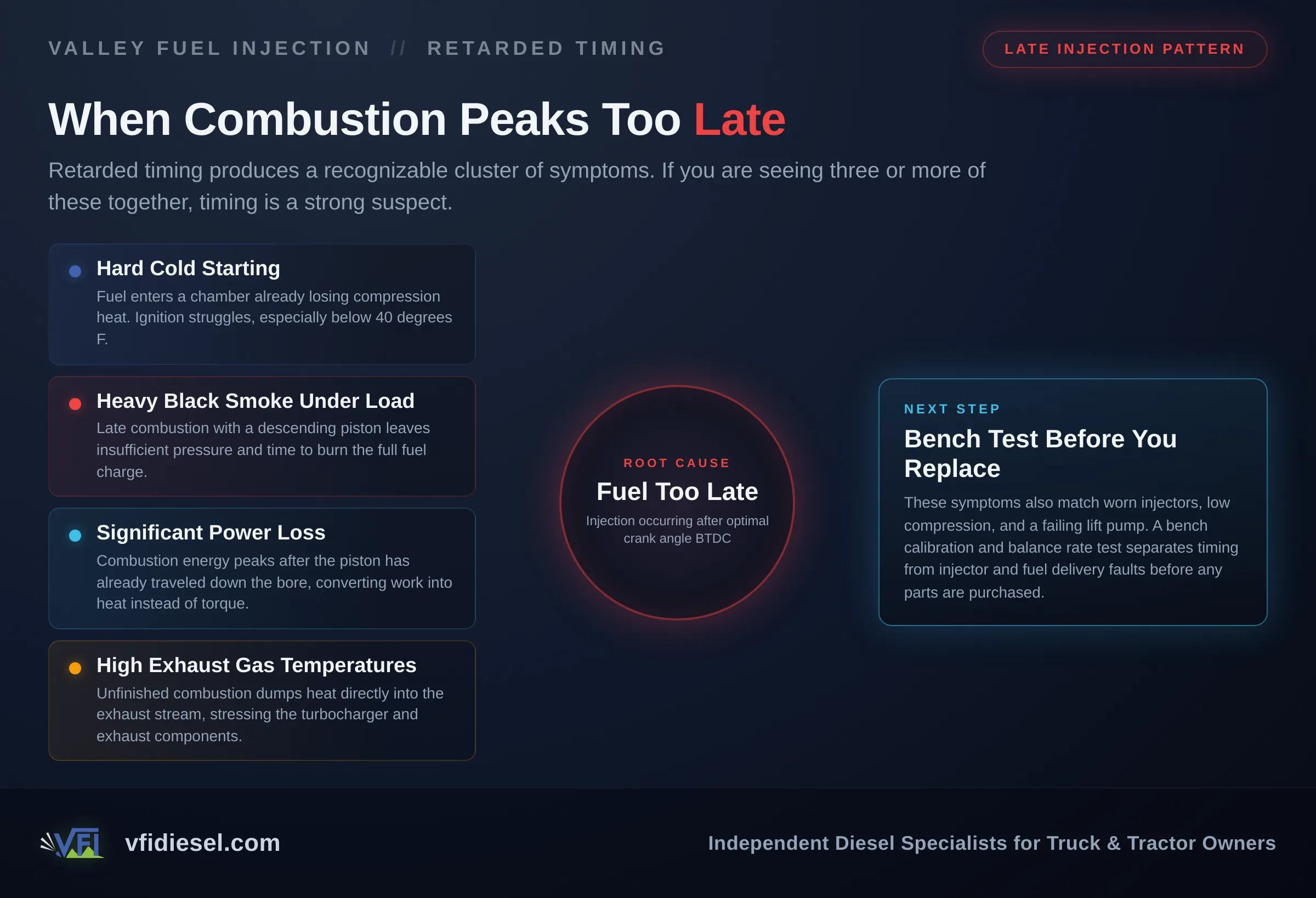
Symptoms of Retarded Timing (Fuel Too Late)
- Hard starting, especially when cold: Late injection means fuel enters a combustion chamber that is already losing compression heat. The mixture struggles to ignite, especially in cold ambient temperatures.
- Heavy black smoke under load: Retarded timing is one of the most common causes of black smoke. Combustion starts late, the piston is already descending, and there is not enough time or cylinder pressure to burn the fuel completely.
- Significant power loss: When combustion peaks late in the stroke, much of the energy is wasted as heat rather than pushing the piston down. The engine feels sluggish and fails to pull grades it handled easily before.
- High exhaust gas temperatures (EGTs): Late combustion dumps heat directly into the exhaust stream. This is hard on turbochargers and exhaust components. EGT gauges will show readings well above the normal operating range.
- Poor fuel economy: Incomplete and late combustion means you’re burning more fuel to accomplish less work.
Timing Too Advanced vs Too Retarded at a Glance
The quickest tell is noise versus heat. Advanced timing gets loud; retarded timing gets hot, smoky and lazy.
| What You Notice | Too Advanced (Fuel Early) | Too Retarded (Fuel Late) |
|---|---|---|
| Engine sound | Sharp, loud knock that gets worse under load | Quieter than normal, lazy throttle response |
| Smoke | Little black smoke under load | Heavy black smoke under load |
| Exhaust temperature | EGTs at or below normal | High EGTs, hard on the turbo |
| What it damages first | Pistons, rings and bearings, from pressure spikes | Turbo and injector tips, from heat |
Black smoke and hard starting are also caused by worn injectors, low compression, a clogged air filter, a failing lift pump, and turbocharger problems. Do not assume timing is the issue without a proper diagnostic. Chasing timing on an engine that actually has a fuel delivery problem or low compression wastes time and money. See our post on diesel injection pump losing prime for one common culprit that mimics timing symptoms.
How Does Timing Drift Differently Between Mechanical Pumps and Common Rail Systems?
Mechanical pumps and common rail systems develop timing problems through entirely different mechanisms, and the repair path is different for each.
Mechanical Rotary and Inline Pumps
On mechanical pumps, timing can drift in three main ways. First, the pump drive gear or coupling can wear, allowing the pump shaft to rotate slightly relative to the engine’s gear train. This produces a consistent offset in timing across all operating conditions. Second, the internal advance mechanism inside the pump can wear or stick. The advance piston, which uses fuel pressure to advance timing under load, may seize in a retarded or advanced position. A stuck advance piston produces symptoms that vary with engine speed: the engine may run reasonably well at idle but produce heavy smoke and power loss when loaded. Third, the pump-to-engine timing can be disturbed any time the pump is removed and reinstalled without proper alignment, a common mistake on farm equipment serviced in the field.
The Stanadyne DB2 and DB4 pumps used on older GM 6.2L and 6.5L diesels, Ford IDI engines, and a wide range of agricultural equipment are particularly susceptible to advance mechanism wear over time. The plastic weight retainer ring inside the DB2 is a known failure point that can cause the advance to stick or behave erratically. You can read more about related injection pump failure patterns in our post on John Deere injection pump problems, which covers many of the same Stanadyne-equipped platforms.
VP44 Electronic Rotary Pumps
The VP44 used on 1998.5–2002 5.9L Cummins engines is an electronically controlled rotary pump that manages timing through an internal solenoid and an integral pump-mounted controller called the PSG. When the PSG fails, timing control is lost entirely. Symptoms include sudden hard starting, rough running, and fault codes. The VP44 is also extremely sensitive to fuel supply pressure. Low supply pressure from a failing lift pump causes the PSG to lose its reference point for timing correction, producing erratic behavior that looks like a timing problem but is actually a fuel delivery issue upstream of the pump.
Common Rail Systems
Common rail systems do not have a mechanical timing mechanism. The ECM calculates injection timing based on inputs from the crankshaft position sensor, camshaft position sensor, rail pressure sensor, and injector feedback. When those inputs are accurate and the injectors respond precisely, timing is controlled to within fractions of a degree. Timing problems in common rail systems typically trace to one of four causes: a failing crankshaft or camshaft position sensor giving the ECM bad reference data; injector wear that causes actual delivery to lag behind commanded delivery; low rail pressure that reduces injection velocity and effectively retards the combustion event; or a failing high-pressure pump that cannot maintain the rail pressure the ECM expects. Our post on CP4 injection pump failures covers how high-pressure pump degradation affects overall system performance, including timing accuracy.
Modern common rail ECMs can compensate for minor injector wear by adjusting injection duration and timing on the fly. This is why symptoms on a common rail engine often appear gradually rather than all at once. By the time you notice the smoke or power loss, the ECM has already been compensating for weeks or months. A balance rate test on a scan tool reveals how hard the ECM is working to correct for individual cylinder timing and fueling errors.
Can Bad Timing Damage Injectors, Pistons, or the Turbocharger?
Yes, and the damage can be severe if timing problems are left uncorrected for extended periods.
Piston and ring damage from over-advanced timing: When fuel fires significantly before TDC, the resulting pressure spike opposes piston travel. This creates extreme mechanical stress on the piston crown, wrist pin, and connecting rod. Prolonged operation with advanced timing causes piston crown erosion, cracking, and in severe cases, piston failure. The SAE International has documented the relationship between injection timing and piston thermal loading extensively in diesel combustion research.
Injector tip damage from retarded timing: Late combustion causes the combustion flame front to linger near the injector tip during the exhaust stroke. This thermal exposure burns and erodes the injector nozzle holes over time, changing spray pattern and making the timing problem progressively worse as the injectors degrade.
Turbocharger damage from high EGTs: Retarded timing consistently pushes exhaust gas temperatures above the turbocharger’s design limits. Variable geometry turbines are especially vulnerable because the vane actuators and unison rings operate within tight thermal tolerances. Sustained high EGTs cause vane seizure, turbine wheel erosion, and bearing failure. See our turbocharger service page for more on how fuel system problems contribute to turbo failures.
Bearing damage from knock: The mechanical knock caused by advanced timing is not just noise. It represents a shock load on the crankshaft main and rod bearings that they are not designed to absorb repeatedly. Extended operation with a hard timing knock accelerates bearing wear and can lead to catastrophic engine failure.
How Is Injection Timing Diagnosed and Corrected at a Certified Shop?
Proper timing diagnosis requires the right equipment and the knowledge to interpret what the readings mean in context. At Valley Fuel Injection, we approach timing diagnosis differently depending on the platform.
Mechanical Pump Timing
For mechanical pumps, diagnosis starts with verifying the static timing using a dial indicator or timing light referenced to the engine’s TDC mark. This confirms whether the pump is correctly positioned relative to the engine. If static timing is correct but symptoms persist, the pump needs to come off the engine for bench testing. On our Bosch-certified test bench, we can run the pump through its full speed and load range, measure delivery timing at each point, and compare the results against the OEM specification. This reveals whether the advance mechanism is functioning correctly, whether delivery is consistent across all ports, and whether internal wear has pushed timing outside of spec.
Correction may involve adjusting the pump-to-engine timing by rotating the pump body, rebuilding or replacing the advance mechanism, or doing a full pump rebuild through our injection pump rebuild services if internal wear is the root cause.
A bench calibration and timing verification typically runs $250–$550 at a California specialty shop. If a rebuild is needed, costs vary by pump type: a Stanadyne DB2 or DB4 rebuild typically runs $950–$1,800, while a Bosch VE pump rebuild ranges from $1,100–$2,000 depending on which internal components need replacement.
VP44 Timing Diagnosis
VP44 timing problems require a scan tool capable of reading Cummins-specific fuel system data, plus a fuel supply pressure test. We always check supply pressure first. If the lift pump is not delivering adequate pressure to the VP44, the pump cannot time correctly regardless of its condition. If supply pressure is good and the PSG is throwing timing-related fault codes, the pump needs to be removed and evaluated. VP44 replacement with a properly remanufactured unit including a new PSG typically runs $1,800–$2,800 for parts plus $500–$750 for labor. Our injection pump exchange program is worth reviewing if you’re facing a VP44 replacement, as it can significantly reduce turnaround time.
Common Rail Timing Diagnosis
Common rail timing diagnosis starts with a scan tool session to pull fault codes, check live rail pressure data, and run a cylinder balance rate test. Balance rates show how much fuel correction the ECM is applying to each cylinder to achieve equal power contribution. Large corrections on one or more cylinders indicate injector wear or failure. We then move to injector return flow testing and, if needed, individual injector bench testing. A full diagnostic session on a common rail system typically runs $185–$400 at our shop.
If injectors are the cause of timing and fueling errors, replacement cost for a full set on a light-duty truck runs $2,800–$5,500 installed, depending on the engine and parts specification. Individual common rail injectors typically run $350–$700 each for a quality remanufactured unit. Most common rail injectors also require trim code programming into the ECM after installation, which adds 0.5–1.0 hours of labor. Skipping this step causes rough idle and fuel balance codes even with new injectors installed. See our common rail service page for more detail on our diagnostic and repair process.
- Timing diagnostic / bench calibration (mechanical pump): typically $250–$550
- Stanadyne DB2 / DB4 pump rebuild: typically $950–$1,800
- Bosch VE pump rebuild: typically $1,100–$2,000
- VP44 pump replacement (parts): typically $1,800–$2,800 + $500–$750 labor
- Common rail diagnostic (scan tool + balance rate): typically $185–$400
- Common rail injector set, light-duty truck (installed): typically $2,800–$5,500
Prices reflect typical California specialty-shop ranges as of 2026. Your actual quote depends on the condition of your specific components, parts availability, and current labor rates. Call VFI at 530-668-0818 for an accurate quote on your job.
Parts and labor vary by region, engine condition, and current pricing. Call us at 530-668-0818 for an accurate quote.
Talk to a Diesel Tech Knock, smoke or hard starts? Get the timing checked Tell us the engine, the pump and what it is doing. We confirm whether it is timing, the advance, or something that only looks like timing, and quote the fix before any work starts. Two ways in: drive it into our Woodland shop near Sacramento, or ship it to us from anywhere in the country. ☎︎ Call 530-668-0818Out of the area? Start a mail-in rebuild → |
Which Diesel Engines and Pumps Are Most Prone to Timing Problems?
Certain platforms show up in our shop repeatedly with timing-related complaints, and it is worth knowing if yours is on the list.
| Engine / Platform | Pump Type | Common Timing Failure Mode |
|---|---|---|
| GM 6.2L / 6.5L Diesel | Stanadyne DB2 / DB4 | Plastic weight retainer failure, advance mechanism sticking |
| Ford 6.9L / 7.3L IDI | Stanadyne DB2 / DB4 | Advance piston wear, timing gear wear on high-mileage engines |
| 5.9L Cummins 12-Valve (P7100) | Bosch P7100 Inline | Timing gear wear, advance spring fatigue, improper timing after pump service |
| 5.9L Cummins 24-Valve (1998.5–2002) | Bosch VP44 | PSG failure, lift pump starvation causing timing errors |
| 5.9L Cummins 12-Valve (VE-equipped) | Bosch VE Rotary | Cam ring and roller wear, advance piston seizure |
| John Deere / AGCO / Kubota Ag Equipment | Stanadyne, Bosch VE, Denso | Timing disturbed during field service, advance wear from extended service intervals |
| 6.7L Cummins / Duramax / 6.7L Power Stroke (2008+) | Common Rail (Bosch / Denso) | Injector wear, rail pressure drop from CP3/CP4 degradation, sensor failures |
If your engine is on this list and you’re seeing any of the symptoms described above, a proper diagnostic is the right first move. Replacing parts without confirming the root cause is expensive on any of these platforms. Diesel truck owners in the Sacramento area and throughout Northern California can bring their vehicles to our Woodland shop for a thorough evaluation. If you’re outside the area, ship the pump or injectors to us through our nationwide mail-in rebuild service for bench testing and rebuilding. Our diesel fuel injection services page covers the full scope of what we do.
For a deeper look at the cost side of pump repair decisions, our diesel injection pump rebuild cost vs. replace guide breaks down when rebuilding makes financial sense versus sourcing a remanufactured exchange unit.
The Bosch Mobility technical resources and EPA diesel fuel standards are also useful references if you’re researching fuel quality’s role in injection system wear, which directly affects timing accuracy over time. The California Air Resources Board (CARB) publishes guidance on diesel emissions compliance that is relevant if your timing problem has triggered a visible smoke violation.
If you’re a fleet manager or equipment operator running multiple diesel units, timing drift is worth adding to your scheduled inspection checklist. A bench calibration during a pump service interval costs far less than diagnosing and repairing the downstream damage from extended off-time operation. Our team at Valley Fuel Injection has been doing this work since 1993, and we can set up a service schedule that keeps your equipment running at spec. See our diesel maintenance services for more on preventive injection system care.
Ready to get your injection timing diagnosed properly? Call us at 530-668-0818 or schedule a diagnostic online. We’re located at 1243 E Beamer St, Suite C, Woodland, CA 95776, serving diesel owners throughout Northern California and Nevada. We also ship remanufactured pumps and injectors nationwide and accept mail-in cores for testing and rebuilding.
Frequently Asked Questions About Diesel Injection Pump Timing Symptoms
Can injection pump timing symptoms be confused with bad injectors?
Yes, and it happens often. Both timing problems and worn injectors cause black smoke, hard starting, and power loss. The key difference is that a timing problem affects all cylinders equally, while worn injectors typically produce uneven cylinder contributions that show up clearly on a balance rate test. A proper diagnostic, including both a timing check and injector testing, is the only reliable way to separate the two. Consult a qualified diesel technician before replacing parts based on symptoms alone.
How much does it cost to fix injection pump timing?
If the pump simply needs to be repositioned on the engine, the repair is relatively inexpensive, typically covered within a standard diagnostic and labor charge of $185–$400. If the pump’s internal advance mechanism is worn and needs rebuilding, costs range from $950 to $2,000 or more depending on the pump type and which internal components need replacement. VP44 replacement on a 24-valve Cummins typically runs $1,800–$2,800 for parts plus $500–$750 for labor. Call Valley Fuel Injection at 530-668-0818 for a quote specific to your engine.
Will a diesel run with the injection pump out of time?
It depends on how far out of time it is. Minor timing errors allow the engine to run but produce noticeable symptoms like smoke, power loss, or knock. Severe timing errors, particularly on mechanical pumps where the drive gear has slipped significantly, can prevent the engine from starting at all. In between those extremes, the engine may start and run but cause progressive damage to pistons, injectors, and the turbocharger the longer it operates out of spec.
Does injection timing affect fuel economy?
Yes, significantly. Retarded timing is particularly hard on fuel economy because late combustion converts less of the fuel’s energy into mechanical work, with the remainder exiting as heat and unburned hydrocarbons. Owners with retarded timing often report fuel economy drops of 10–20% or more before other symptoms become obvious. Correcting timing to spec typically restores fuel economy along with power output and smoke levels.
Can I check injection pump timing myself?
Static timing on some mechanical pumps can be checked with basic tools if you have access to the OEM specification and a dial indicator or timing light. However, this only tells you whether the pump is positioned correctly at a single reference point. It does not tell you whether the advance mechanism is working, whether delivery is consistent across all ports, or whether the pump is calibrated to spec across its operating range. For a complete and accurate timing evaluation, bench testing at a certified shop is the right approach. We recommend consulting a qualified diesel technician for any timing adjustment or pump service.
Related guides from Valley Fuel Injection
- Injection Pump Rebuild Cost vs Replace: 2026 Guide
- CP4 Injection Pump Failures: Symptoms, Causes & Costs
- 5.9 Cummins VP44 Injection Pump Failure Guide
Think your pump timing is off? Valley Fuel Injection bench-tests, rebuilds, and re-times mechanical and electronic injection pumps to factory spec. Bosch-authorized, Woodland CA, nationwide mail-in. Call 530-668-0818.