
Diesel Injector Deposit Buildup: Symptoms & Causes
07/22/2026
New Stanadyne DB2, DB4 & DE Injection Pumps: John Deere, CAT & Perkins Applications
07/22/2026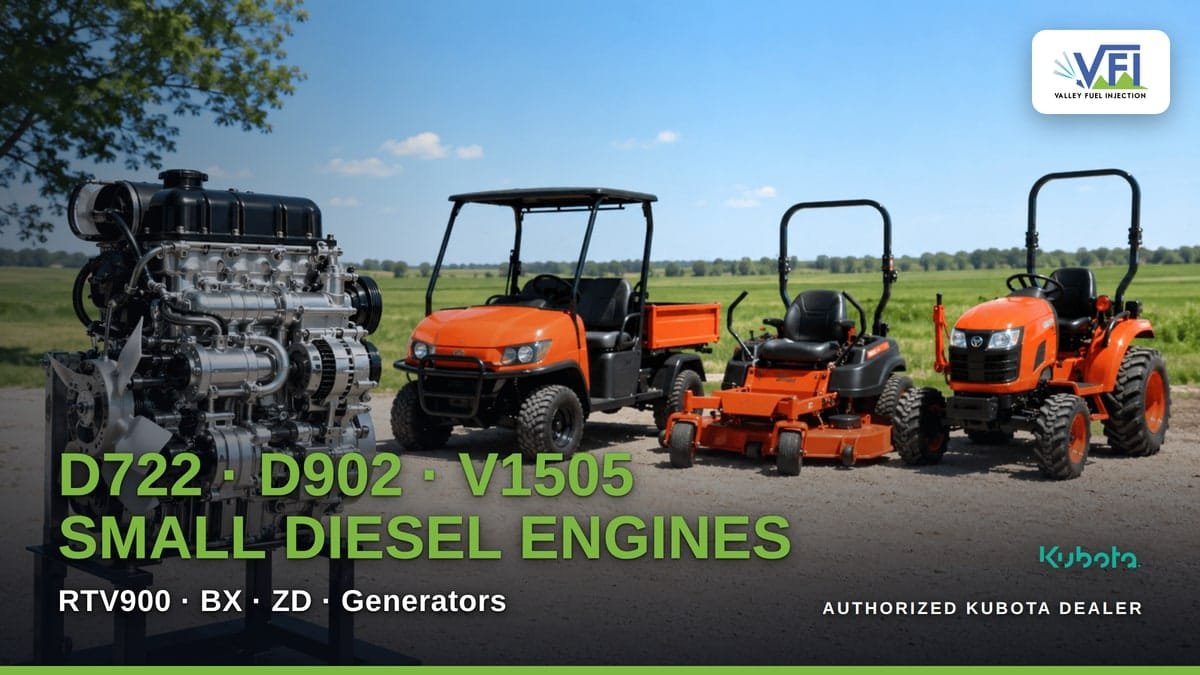
If you own a Kubota RTV900, a BX series tractor, a ZD zero-turn mower, or a small diesel generator, sooner or later you end up comparing small Kubota diesels. The Kubota D722 vs D902 vs V1505 question usually comes up at the worst possible time: the engine is knocking, smoking, or seized, and every search result is either a bare spec table or a parts listing with no real guidance.
This guide covers what those pages skip: which engine is actually in your machine, what decides how long these engines last, what a rebuild or replacement costs in 2026, and which swaps work (and which absolutely do not).
Valley Fuel Injection is an authorized Kubota engine dealer and a diesel fuel injection specialty shop in Woodland, California, in business since 1993. What follows is owner-grade decision advice, not a reworded spec sheet.
Which Engine Is in Your Kubota? (RTV900, BX, ZD, Generators)
The most repeated and most expensive mistake owners make is ordering an engine or parts by family name instead of the full specification code. Forum threads are full of buyers who purchased “a D902” for an RTV900 and received a tractor-spec engine with the wrong mounts, pan, and accessory drives. Start with this table, then confirm against the code stamped on your engine’s ID tag.
Reading the suffix: the base code (D722, D902, V1505) identifies the family and displacement. The E2, E3, or E4 that follows is the emissions tier generation, and application letters like UV mark the equipment spec. Rebuilder listings such as D902ER-RTV or D902ER-AG are exchange-rebuild designations tied to those applications. The practical rule: oil pans, flywheel housings, mounts, exhaust manifold orientation, and accessory drive gears all change with application, even within one engine family, so buy against the full code on your engine tag, never against the family name alone.
Talk to a Diesel Tech Read us the full code off your engine tag As an authorized Kubota engine dealer we will match the right engine or parts to that code, so a tractor-spec D902 never shows up for your RTV900. Two ways in: drive it into our Woodland shop near Sacramento, or ship it to us from anywhere in the country. ☎︎ Call 530-668-0818Out of the area? Start a mail-in rebuild → |
Kubota D722 vs D902 vs V1505: How Do the Specs Compare?
The mechanical D722, D902 and V1505 versions covered here share the same basic architecture: liquid cooled, indirect injection with Kubota’s E-TVCS swirl chamber design, a mechanical injection pump, and one glow plug per cylinder. That simplicity is why they are everywhere, from mowers to light towers. Kubota also makes an electronic common rail D902.
Here is the honest truth about the comparison itself: for most owners, the machine already chose the engine for you. The questions that actually cost or save you money are the ones below: how long the engine will last, what replacement really costs, and whether a cheaper sibling engine can be swapped in.

What Decides How Long Kubota D722, D902, and V1505 Engines Last?
How long one of these engines lasts is not luck. It comes down to three things.
Overheating is the deal breaker
These engines carry small coolant volumes and tight tolerances, and the consensus from decades of owner experience is blunt: Kubotas do not stand overheating. Cook one and the rings lose their temper, compression fades, and a failure can follow hundreds of hours later, long after the gauge went back to normal.
On RTVs and ZD mowers the usual trigger is a radiator screen packed with mud, chaff, or grass clippings. On mini skid steers and tightly packaged gensets, some OEM installations run the D722 with a thin cooling margin from the factory, and the engine takes the blame for a packaging problem. If you buy one of these machines used, treat any overheat history as a compression test waiting to happen.
The fuel system decides the second half of engine life
Nozzle condition is a big part of what separates a long-lived engine from a short-lived one. A dribbling nozzle washes the oil film off one cylinder wall and overfuels that cylinder every stroke, so the wear it causes is quiet and cumulative. Our guides on how long diesel injectors last and Kubota injector maintenance cover the service side; the short version is that pop testing nozzles at mid-life is the cheapest engine-life insurance these engines can get.
Scored cylinders raise the stakes
Once a bore is scored, from dust ingestion, a broken ring after an overheat, or a washed cylinder, you cannot simply hone and re-ring it. The block needs boring and oversize pistons, which means machine work, more parts, and full disassembly. That single fact flips a lot of rebuild math toward a short block or exchange engine, which is exactly the decision the next section prices out.
What Does It Cost to Rebuild or Replace a D902, D722, or V1505 in 2026?
First, the trap nobody warns RTV owners about: on an RTV900 the engine and transaxle come out of the frame as a unit. That is why shop quotes for a full engine swap shock people, and it is why the known workaround, an in-frame re-ring and hone done through the machine without pulling the driveline, exists at all. It only works if the bores are clean and unscored, which is worth verifying with a borescope before you commit either way.
Two more data points from the real market. Freshly rebuilt import engines from overseas sellers land at roughly a third of US exchange pricing, and owners are understandably tempted; the risk is parts quality, spec-code mismatches, and warranty support that evaporates when something goes wrong.
Run the donor-machine math before writing any check: complete running older RTV900s sometimes sell for less than a rebuilt engine plus installation labor, which is exactly why some owners sell a dead machine rather than repair it.
Finally, whichever route you choose, service the injection side while everything is accessible. Reinstalling worn injectors and a tired pump on a fresh bottom end shortens a rebuild’s life, and a tractor injection pump rebuild costs a fraction of doing the job twice.
Kubota D722 vs D902 Swaps: Are They Interchangeable?
No, not directly, even though the two engines look like twins on a pallet. Owners who have actually done the swap into an RTV900 document three hard problems:
- The D722 camshaft lacks the spur gear that drives the RTV’s hydraulic and power steering pump, so the smaller engine cannot power systems the machine depends on.
- The engine mounts do not line up, and the documented swaps involved welding and fabricating mounts.
- The exhaust manifold bolts to the head differently, so the exhaust plumbing does not carry over.
A determined fabricator can make it run; it is not a bolt-in, and you give up horsepower doing it.
The same warning applies inside the family. A D722 will not directly replace the D782 in a ZD21: the oil pan and water inlet are different, and ZD owners who tried to save money on the smaller engine learned that the hard way. And repeating the fitment section’s biggest trap, the BX2200’s D905 is a different engine series entirely, so D902 parts and engines are not the answer there either.
Gas swaps (a Predator 670 or a 999 cc 35 hp V-twin) come up constantly in repower threads, but remember what the diesel was quietly doing besides moving the machine: RTV hydraulic oil cooling and cab heat both depend on it, so a gas conversion has to engineer solutions for both. For a machine that earns its keep, our advice is to stay diesel and stay with the correct spec code.
Why Won’t Your D722 or V1505 Start or Stay Running?
The classic D722 complaint pattern is hard cold starting, a loping idle, and white smoke at startup. On this engine specifically, work the glow plug circuit first: these small swirl-chamber diesels are heavily glow plug dependent, and one dead plug out of three is obvious on a cold morning. Next comes injector condition, because tired nozzles turn cold starts into smoke shows, and finally compression, since an IDI engine with worn rings loses cold-start ability before it loses power.
Our guides on diesel cold start problems and diesel white smoke cover the universal causes; the D722-specific note is that a chronic hard starter that also lopes at idle usually has fuel delivery or compression trouble, not just glow plugs.
The V1505 pattern owners report is different: the engine cranks but will not start, or it starts and stalls after a few seconds. On this engine, check the fuel stop solenoid first. It has to pull in and then hold; when the holding function fails, the engine fires and dies almost immediately, which matches the stall-after-ten-seconds complaint almost perfectly.
After that it is fuel delivery: a system that has lost prime or pulled air through a filter change will crank endlessly, and these mechanical systems need proper bleeding afterward, covered in our Kubota fuel system bleeding guide. For the broader diagnostic tree, start with why a diesel cranks but won’t start.
One more V1505 note for generator owners: a genset governed at 1,800 rpm that surges or hunts under light load often has worn nozzles or sticking governor linkage, and a nozzle pop test quickly shows whether the nozzles are the problem. If you are not near a shop, our mail-in injector testing service handles exactly this.
Frequently Asked Questions
How much does it cost to replace a Kubota RTV900 engine?
Plan around these 2026 ranges: a DIY in-frame re-ring runs typically $600-$1,000 in parts, an OEM short block typically $2,200-$2,800, and a US rebuilt exchange engine typically $4,500-$6,000 plus a core charge. Labor is the wildcard, because the RTV900’s engine and transaxle come out as a unit. Always compare the total against the value of a running used machine before committing.
What engine is in a Kubota RTV900, and what else will fit?
The RTV900 uses UV-spec D902 variants (D902-E-UV through D902-E3-UV depending on year). The only true drop-in is the matching spec D902. A D722 physically resembles it but lacks the cam spur gear that drives the hydraulic and power steering pump, and larger D1105 repowers require real fabrication.
Are the Kubota D722 and D902 interchangeable?
Not directly. Documented swaps required fabricated mounts, different exhaust manifold arrangements, and in RTV applications the D722 cannot drive the hydraulic and power steering pump because its camshaft lacks the spur gear. Treat any D722-for-D902 swap as a fabrication project, not a parts swap.
What decides how many hours a Kubota D902 will last?
It depends on how the engine was treated. The longest-lived engines are the ones that never overheated and had their injectors serviced, so maintenance history matters far more than the hour meter.
Is the Kubota BX2200 engine a D902?
No. The BX2200 uses the 05-series D905, a different engine family from the Super Mini D902 despite similar displacement. Ordering D902 parts or engines for a BX2200 is one of the most common and expensive fitment mistakes owners make. The BX2230 and BX2350 are the BX models that actually use the D902.
Will a D722 replace a D782 in a ZD21 mower?
No, not directly. The D722 has a different oil pan and water inlet than the D782, so it is not a bolt-in replacement. Source a D782 or a correctly converted engine for a ZD21.
Why does my V1505 crank but not start, or stall after a few seconds?
Start with the fuel stop solenoid: if it pulls in but fails to hold, the engine fires and dies within seconds. After that, check for lost prime or air in the fuel system, restricted filters, and glow plug function on cold starts. If a V1505 cranks well but won’t start, check the fuel stop solenoid, fuel delivery and air in the fuel first.
Get the Right Kubota Engine the First Time
Valley Fuel Injection is an authorized Kubota engine dealer and a diesel fuel injection specialty shop in Woodland, California, serving owners and fleets since 1993. Whether you need a complete engine priced against the exact spec code on your tag, a short block, injectors, or a pump gone through before a rebuild goes back together, we can spec it, test it, and stand behind it. Call us at 530-668-0818 or contact us online. Not local? Our mail-in service handles injector testing and pump rebuilds for Kubota owners nationwide.