5.9 Cummins P7100 vs VP44: Which Is More Reliable?
06/22/2026
Diesel Injection Pump Timing Symptoms Explained
06/24/2026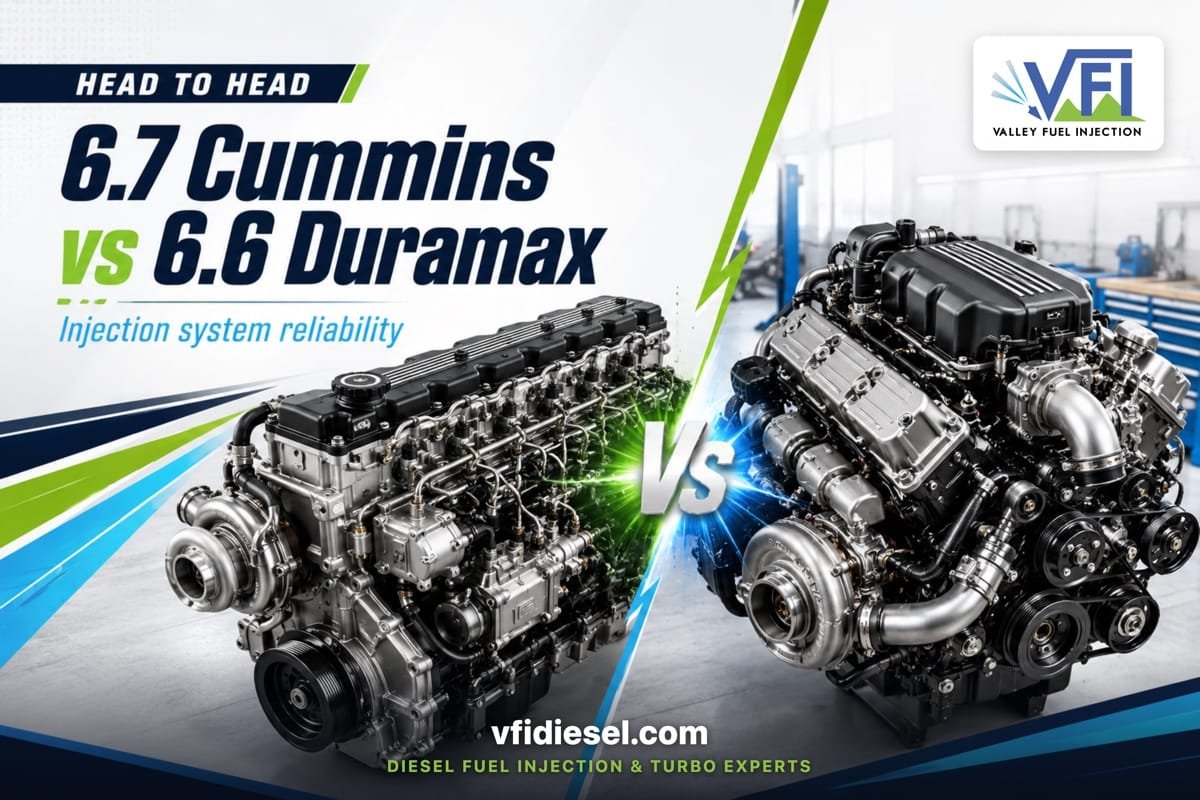
6.7 Cummins vs 6.6 Duramax: Which Diesel Injection System Is More Reliable?
When it comes to 6.7 Cummins vs 6.6 Duramax reliability, both platforms are capable, well-engineered diesel systems, but they fail in very different ways, and the cost of those failures varies significantly. We see both trucks regularly on the bench at our Woodland, CA shop, and after 30-plus years of working on diesel fuel injection systems, we can tell you that the answer depends heavily on which generation of Duramax you’re talking about, how the truck has been maintained, and what kind of fuel it’s been running. This post breaks down the injection systems on both platforms from a specialist’s perspective, not a truck-reviewer’s.
Both the 6.7 Cummins and 6.6 Duramax use high-pressure common rail injection, but their failure modes, repair costs, and maintenance requirements differ enough that the “more reliable” platform depends on the specific generation, mileage, and how well the fuel system has been maintained. The 2019–2020 Cummins CP4.2 and the 2011–2016 Duramax LML CP4 are the highest-risk variants on both sides.
How Are the 6.7 Cummins and 6.6 Duramax Fuel Injection Systems Fundamentally Different?
Both engines use Bosch common rail direct injection, but the pump architecture and injector count separate them immediately. The 6.7 Cummins is an inline-6, so it runs 6 injectors. The 6.6 Duramax is a V8, so it runs 8 injectors. More injectors means more potential failure points and higher parts cost when something goes wrong.
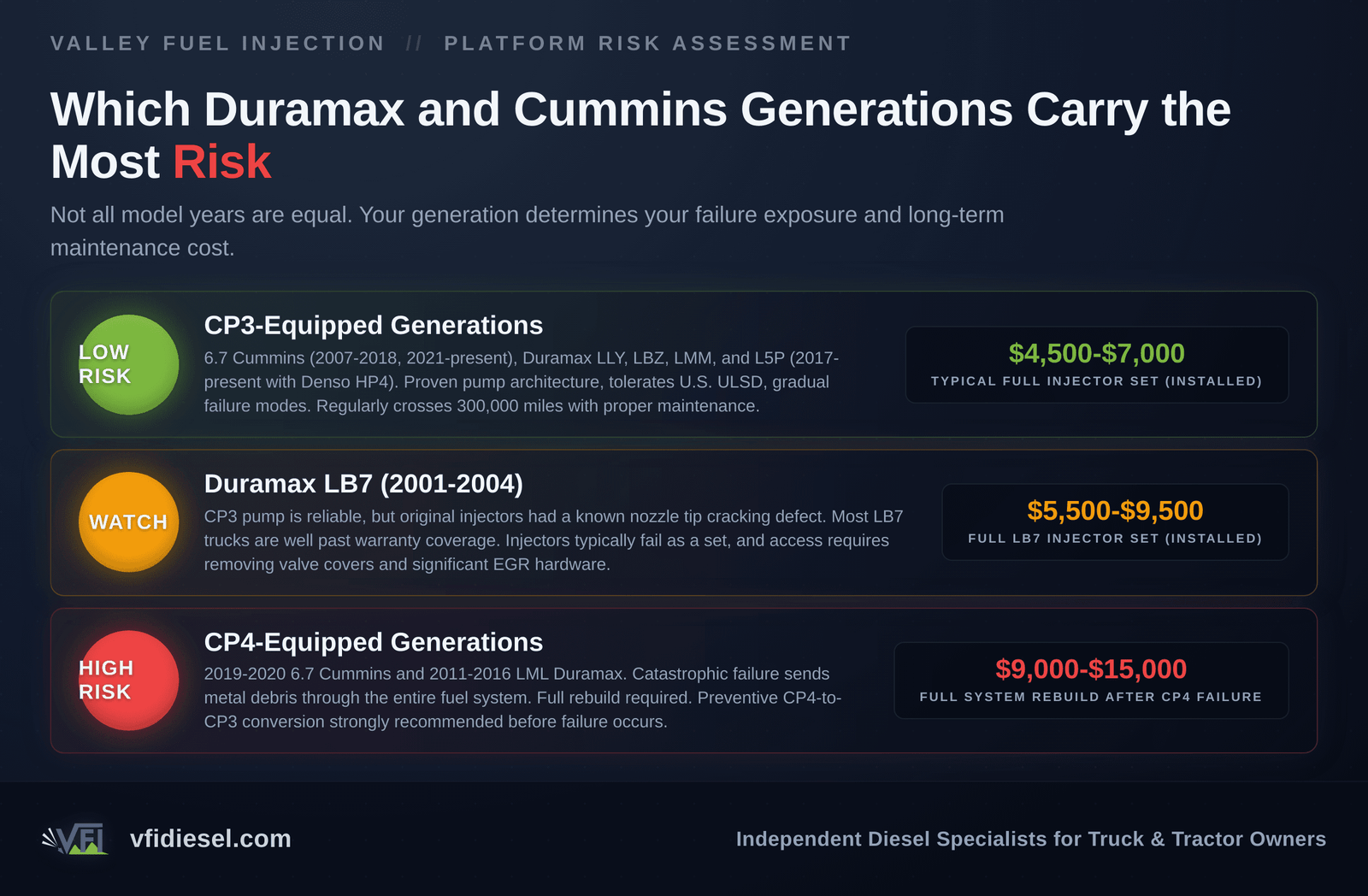
The high-pressure pump is where the real story begins. Most 6.7 Cummins trucks (2007–2018 and 2021–present) use a Bosch CP3 pump, which has an excellent long-term reliability record. The 2019–2020 model years switched to a CP4.2, which introduced the same catastrophic failure risk that plagued certain Duramax owners years earlier. On the Duramax side, the LB7 (2001–2004) used a CP3, the LLY through LMM (2004–2010) also ran CP3-based systems, the LML (2011–2016) switched to the CP4.2, and the L5P (2017–present) moved to a Denso HP4 pump entirely.
Injector design also differs. Cummins uses solenoid-actuated injectors on most generations, while later Duramax variants use piezoelectric injectors on certain builds. Piezo injectors are faster and more precise, but they are also more sensitive to fuel contamination and more expensive to replace. The common rail system architecture is similar in principle, but the components, tolerances, and failure modes are platform-specific enough that you really need a specialist who works on both.

The Bosch CP3 pump used in the 6.7 Cummins (most years) and earlier Duramax generations was designed to tolerate U.S. ultra-low sulfur diesel (ULSD) better than the CP4. The CP4 was engineered for European diesel fuel, which has higher lubricity. That mismatch is the root cause of most CP4 catastrophic failures in North America. Bosch’s own documentation on common rail systems explains the lubricity sensitivity of high-pressure pump components.
What Are the Most Common Injection System Failure Points on the 6.7 Cummins?
The 6.7 Cummins injection system is generally robust, but it has three well-documented weak points that we see repeatedly: CP4.2 pump failure on 2019–2020 trucks, injector return line o-ring degradation, and rail pressure sensor drift.
CP4.2 Catastrophic Failure (2019–2020 Only): Dodge/Ram used the CP4.2 for two model years before reverting to the CP3. When the CP4.2 fails, it sends metal debris through the entire high-pressure fuel circuit, contaminating the injectors, fuel rails, and high-pressure lines. This is not a pump-swap job. It requires replacing the pump, all six injectors, the high-pressure lines, and cleaning or replacing the low-pressure supply circuit. We’ve seen fuel tanks that needed to be dropped and cleaned as well. If you own a 2019–2020 Ram with the 6.7 Cummins and you haven’t already done a CP4-to-CP3 conversion, that conversation is worth having before something goes wrong.
Injector Return Line O-Rings: On higher-mileage 6.7 Cummins trucks, the o-rings on the injector return lines degrade and cause fuel to leak at the top of the injectors. This shows up as a hard-start condition, white smoke at startup, or a fuel smell in the engine bay. It’s a relatively inexpensive fix compared to injector replacement, but it gets misdiagnosed as injector failure more often than it should be.
Rail Pressure Sensor and Fuel Pressure Regulator: These are wear items on any common rail system, but the 6.7 Cummins seems to go through rail pressure sensors more frequently than average, particularly in trucks that have seen a lot of idle time or inconsistent fuel quality. A failing pressure sensor can mimic injector symptoms, so proper diagnostics before pulling injectors matters a great deal.
If you own a 2019–2020 6.7 Cummins, a preventive CP4-to-CP3 conversion typically runs $3,500–$5,500 in parts and labor at a California specialty shop. That’s a fraction of the $8,000–$13,000 you’re looking at for a full fuel system rebuild after a catastrophic CP4.2 failure. Our post on injection pump rebuild cost vs. replace covers the decision framework in detail.
What Are the Most Common Injection System Failure Points on the 6.6 Duramax?
The Duramax story is more complicated because there are more generations with meaningfully different failure profiles. The LB7, LML, and L5P each have their own injection system weak points.
LB7 (2001–2004): Injector Failure at High Mileage: The LB7 is notorious for injector failure, and it earned that reputation honestly. The original injectors had a design flaw that caused the nozzle tip to crack under the thermal cycling of normal use. GM extended the warranty on these injectors twice, but most LB7 trucks are well past any coverage now. When LB7 injectors fail, they typically fail as a set, and the labor to replace all eight is substantial. Access requires removing the valve covers and a significant amount of intake and EGR hardware. A full set installed at a California specialty shop typically runs $5,500–$9,500.
LML (2011–2016): CP4.2 Catastrophic Failure: This is the highest-stakes failure mode in the Duramax lineup. The LML’s CP4.2 pump has the same metal-debris contamination failure mode as the 2019–2020 Cummins. When it goes, it contaminates the entire fuel system. Full fuel system replacement on an LML typically runs $9,000–$15,000 at a California specialty shop, and that’s assuming no engine internal damage from prolonged operation after failure onset. Our team has worked through enough of these to say clearly: the LML CP4 failure is the worst-case scenario on either platform in terms of total repair cost.
L5P (2017–Present): Injector Access and Programming: The L5P moved to a Denso HP4 pump, which eliminated the CP4 failure mode. That’s genuinely good news. But the L5P has a different problem: injector access is brutal. Replacing injectors on the L5P requires removing inner fender liners, the air intake assembly, and complex EGR piping before you even get to the injectors. That access difficulty adds 2–4 hours of labor compared to the Cummins, and injector programming on the L5P requires dealer-level or specialist-level software. A full set of L5P injectors installed typically runs $5,000–$8,000.
For a deeper look at how Duramax injection issues show up in real-time diagnostics, our post on Duramax injector balance rates explains exactly what the data looks like when injectors start to drift.
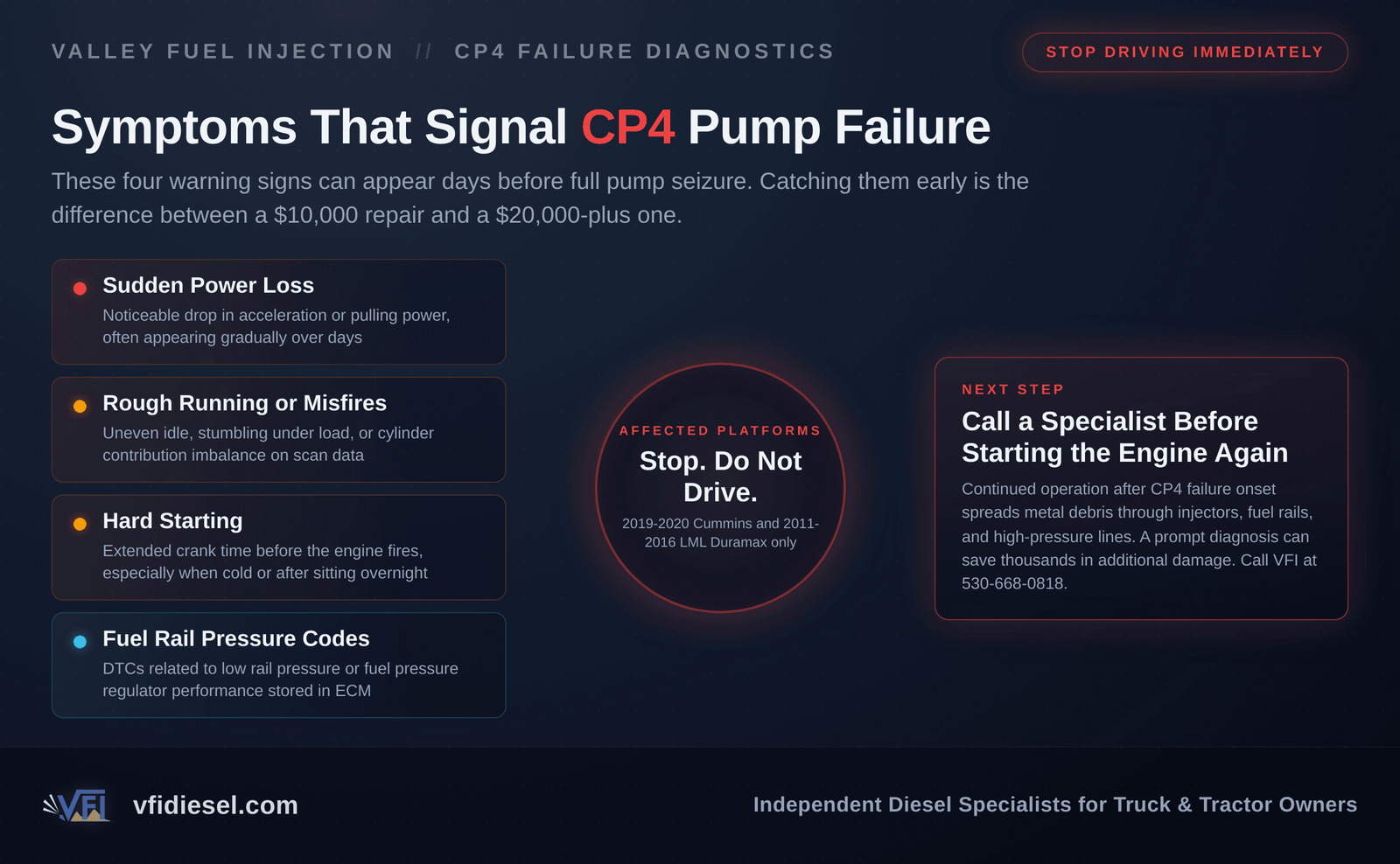
On both the LML Duramax and 2019–2020 6.7 Cummins, a CP4 failure does not always announce itself dramatically. Some trucks show a gradual loss of power and rough running for days before the pump seizes. If you notice any of these symptoms on a CP4-equipped truck, stop driving it and have it diagnosed immediately. Continuing to run the engine after CP4 failure onset spreads debris further into the system and can turn a $10,000 repair into a $20,000-plus one.

Which Platform Is More Expensive to Repair When the Injection System Fails?
In a head-to-head cost comparison, the Duramax LML is the most expensive platform to repair when a catastrophic injection failure occurs, but the 6.7 Cummins (2019–2020) is close behind. For routine injector wear and replacement, the Duramax costs more because of the additional injector count and access difficulty.
| Repair Scenario | 6.7 Cummins | 6.6 Duramax |
|---|---|---|
| Full injector set (installed) | $4,500–$7,000 (6 injectors) | $5,500–$9,500 (8 injectors, LB7/LML) |
| CP4 catastrophic failure (full system rebuild) | $8,000–$13,000 (2019–2020 only) | $9,000–$15,000 (LML, 2011–2016) |
| Preventive CP4-to-CP3 conversion | $3,500–$5,500 | $3,500–$5,500 |
| Single injector R&R (diagnostic + one injector) | $800–$1,600 | $800–$1,600 |
| Injector coding / trim calibration | $200–$400 | $200–$400 |
Prices reflect typical California specialty-shop ranges as of 2026. Your actual quote depends on the condition of your specific components, parts availability, and current labor rates. Call VFI at 530-668-0818 for an accurate quote on your job.
One cost factor that often gets overlooked: injector programming. On late-model Cummins common rail trucks, injector trim codes need to be programmed after replacement. This is sometimes bundled into the quote and sometimes listed as a separate line item. Always confirm before you authorize the work. Our Bosch injector testing and repair page covers what’s involved in proper bench testing and calibration before installation.
Prices reflect typical California specialty-shop ranges as of 2026. Your actual quote depends on the condition of your specific components, parts availability, and current labor rates. Call VFI at 530-668-0818 for an accurate quote on your job.
If you’re in the Sacramento area and dealing with injection issues on either platform, our team at Valley Fuel Injection serves Sacramento and the surrounding region with the same Bosch-certified diagnostic and repair capabilities available at our main shop.
Talk to a Diesel Tech Big injection quote on your Cummins or Duramax? Call with the year and what the truck is doing before you approve a pump or a full injector set. A bad rail pressure sensor or leaking return o-rings can pass for failed injectors. Two ways in: drive it into our Woodland shop near Sacramento, or ship it to us from anywhere in the country. ☎︎ Call 530-668-0818Out of the area? Start a mail-in rebuild → |
How Do Maintenance Practices Differ Between the Two Platforms to Prevent Premature Failure?
Fuel quality and filtration are the single biggest variables in injection system longevity on both platforms, but the specifics differ between Cummins and Duramax.
Fuel Quality: Both platforms are sensitive to low-lubricity ULSD, but the CP4-equipped trucks (2019–2020 Cummins and 2011–2016 LML Duramax) are especially vulnerable. Running a quality lubricity additive in these trucks is not optional in our opinion. It’s cheap insurance. Stanadyne Performance Formula and Power Service are both solid choices. California’s increasing biodiesel blend percentages add another layer of complexity here, high-percentage biodiesel blends can cause injector tip deposits and nozzle coking that accelerate wear. We covered this in detail in our post on biodiesel injector damage and California’s fuel situation.
Filtration: The 6.7 Cummins has a solid factory filtration setup, but adding an aftermarket lift pump with integrated filtration (like a FASS or AirDog system) is one of the best investments you can make on either platform. These systems typically run $800–$1,400 installed and provide 2-micron or better filtration upstream of the high-pressure pump. On the Duramax side, the factory filter housing is adequate for normal use, but the filter change interval matters. Stretching filter intervals on a high-mileage LML is a risk that isn’t worth taking.
Water Contamination: The 6.7 Cummins has a water-in-fuel sensor and a drain port on the fuel filter housing. Use it. Draining the water separator at every oil change is a simple habit that prevents a lot of downstream injector damage. The Duramax has a similar system, but the drain procedure is less intuitive and gets skipped more often in our experience.
Injector Cleaning: Both platforms benefit from periodic professional injector cleaning at high mileage, particularly if the truck has seen a lot of short-trip, low-load operation. Our post on diesel fuel injector cleaning: DIY vs. professional service walks through when cleaning makes sense vs. when replacement is the right call.
On any CP4-equipped truck, consider having your fuel tested for lubricity if you’re buying from a regional supplier rather than a major chain. The ASTM D6079 lubricity standard is what fuel suppliers are supposed to meet, but real-world testing shows significant variation, especially in California where refinery blending practices change seasonally.
Which Truck’s Injection System Holds Up Better at High Mileage, and What Does the Data Say?
At high mileage, the non-CP4 versions of both platforms hold up remarkably well with proper maintenance. The 6.7 Cummins with a CP3 pump (2007–2018 and 2021-present) regularly crosses 300,000 miles without major injection system work beyond injector o-rings and sensor replacements. The earlier Duramax generations (LLY, LBZ, LMM) with CP3 pumps have a similar track record.
The SAE’s published research on common rail injector wear consistently points to fuel cleanliness and lubricity as the primary drivers of injector service life, regardless of platform. That’s consistent with what we see in the shop. The trucks that come in with 250,000-mile injectors that still bench-test within spec are almost always the ones where the owner ran quality fuel, changed filters on schedule, and used a lift pump system.
Where the data gets more sobering is on the CP4-equipped variants. Failure rates on the LML CP4 were significant enough that a class-action lawsuit was filed against GM, and the 2019–2020 Cummins CP4.2 saw enough early failures that Ram reverted to the CP3 for 2021. That’s not a coincidence. The EPA’s ULSD mandate, which reduced sulfur content from 500 ppm to 15 ppm, inadvertently reduced the lubricity of U.S. diesel fuel at exactly the time manufacturers were adopting pumps engineered for higher-lubricity European diesel. The CP4 was caught in that gap.
For the non-CP4 generations, we’d call it roughly even at high mileage. The Cummins has a slight edge in terms of injector access and parts cost (6 vs. 8 injectors), but the Duramax LB7 and LML trucks that have been properly maintained and had their injection systems serviced proactively are genuinely durable platforms.
If you’re in the Reno or Northern Nevada area and running either of these platforms in demanding conditions, our Reno-area diesel injection service page has information on how to get your truck to us for diagnostics or bench testing, including our mail-in pump and injector testing service for customers who can’t make the drive to Woodland.
If you’re choosing between a CP3-equipped 6.7 Cummins and a CP3-equipped Duramax (LLY/LBZ/LMM), both are solid long-term platforms. Avoid the 2019–2020 Cummins and the 2011–2016 LML Duramax unless you’re prepared to do a preventive CP4 conversion or you’ve already confirmed the previous owner did. The L5P Duramax (2017-present) is a strong platform with the Denso HP4 pump, but budget for higher labor costs on any injector work. The 6.7 Cummins (non-CP4 years) is the most cost-effective platform to maintain and repair at high mileage, primarily because of the lower injector count and simpler access.
Whether you’re diagnosing a rough-running Cummins or dealing with a suspected Duramax injector issue, our team at Valley Fuel Injection has the bench testing equipment and the platform-specific experience to get it right. We’re an authorized Bosch and Delphi service center, and we work on both platforms regularly. Call us at 530-668-0818 or schedule a diagnostic. We also ship remanufactured injectors and accept mail-in pumps for testing and rebuilding nationwide.
Frequently Asked Questions
Is the 6.7 Cummins or 6.6 Duramax more reliable overall?
From a fuel injection standpoint, the CP3-equipped 6.7 Cummins (2007–2018 and 2021-present) has a slight reliability edge because of its lower injector count, simpler access, and proven CP3 pump. The 2019–2020 Cummins and 2011–2016 LML Duramax are the highest-risk variants on both sides due to the CP4.2 pump. Non-CP4 Duramax generations (LLY, LBZ, LMM, L5P) are also reliable platforms with proper maintenance.
How do I know if my 6.7 Cummins or Duramax has a CP4 pump?
On the Cummins side, only the 2019–2020 model years used the CP4.2. All other 6.7 Cummins model years use the CP3. On the Duramax side, the LML (2011–2016) used the CP4.2. The LB7 through LMM used CP3-based systems, and the L5P (2017-present) uses a Denso HP4 pump. If you’re unsure, a diesel injection specialist can confirm the pump type during a diagnostic inspection.
What are the warning signs of CP4 pump failure on a Cummins or Duramax?
Early warning signs include loss of power, rough running, hard starting, and fuel rail pressure codes. Some CP4 failures happen suddenly with no warning, while others show a gradual decline over days. If you notice any of these symptoms on a CP4-equipped truck, stop driving it immediately and have it diagnosed. Continuing to run the engine after failure onset spreads metal debris through the entire fuel system and dramatically increases repair costs.
How much does it cost to replace injectors on a 6.7 Cummins vs. 6.6 Duramax?
A full set of injectors on the 6.7 Cummins (6 injectors, installed) typically runs $4,500–$7,000 at a California specialty shop. The 6.6 Duramax (8 injectors) typically runs $5,500–$9,500 depending on the generation, with LB7 and LML trucks at the higher end due to access difficulty and parts cost. Prices vary based on OEM vs. reman parts, engine condition, and current labor rates.
Can I ship my injectors or pump to Valley Fuel Injection for testing?
Yes. Valley Fuel Injection accepts mail-in injectors and pumps from customers nationwide for bench testing, remanufacturing, and rebuilding. We’re a Bosch-certified facility with the equipment to properly test and calibrate both Cummins and Duramax injection components. Call us at 530-668-0818 or visit our contact page to arrange a mail-in service.
Get a Straight Answer From Specialists Who’ve Seen Both
We work on 6.7 Cummins and 6.6 Duramax injection systems every week. If your truck is showing symptoms, or if you want a professional opinion before buying a used diesel, call us at 530-668-0818 or schedule a diagnostic online. Our shop is located at 1243 E Beamer St, Suite C, Woodland, CA 95776. We also ship remanufactured injectors and accept mail-in pumps for testing and rebuilding nationwide.
Related guides from Valley Fuel Injection
- 6.7 Cummins Injector Problems: Symptoms, Diagnosis & Repair
- 6.6 Duramax LB7 Injector Replacement: Costs & Process
Cummins or Duramax injection work? Valley Fuel Injection bench-tests and remanufactures injectors and pumps for both platforms, with local NorCal service and nationwide mail-in. Arrange mail-in testing or call 530-668-0818.