Diesel Injection Pump Pressure Test: What Numbers Mean
07/28/2026
Diesel Turbocharger Oil Contamination: Causes & Fixes
08/03/2026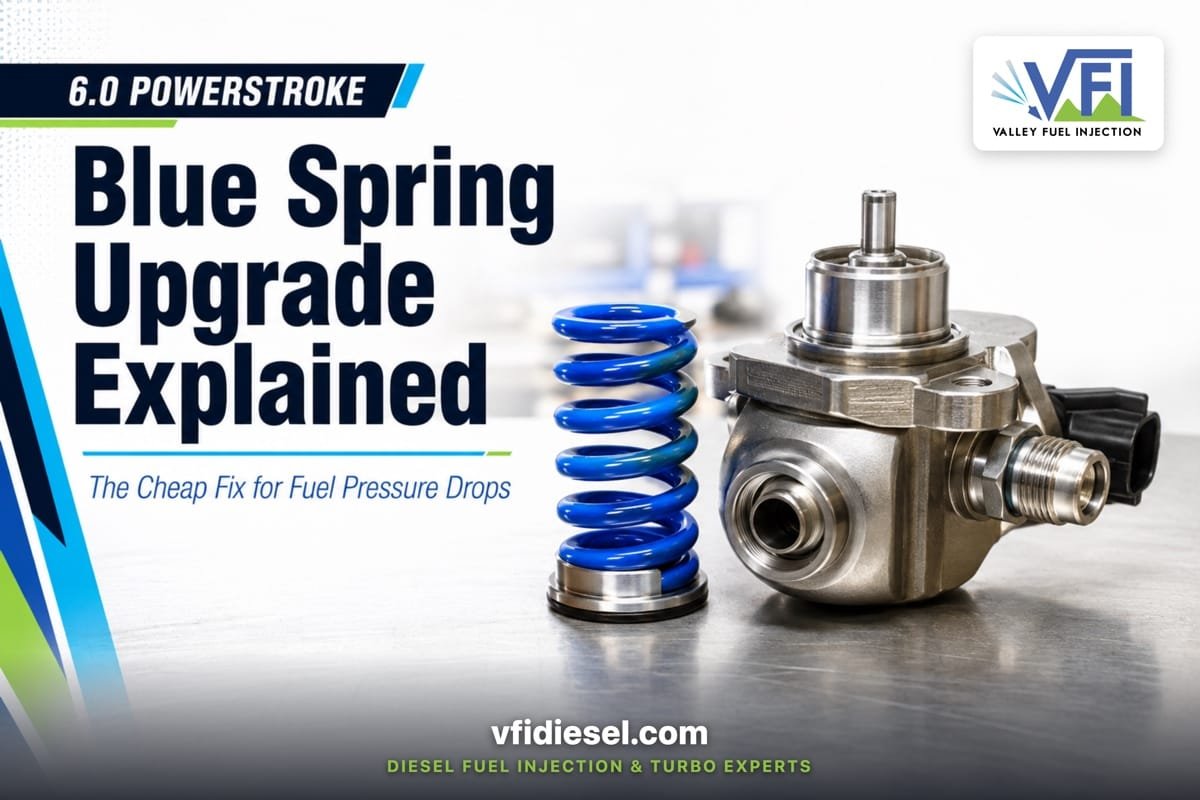
6.0 Power Stroke Blue Spring Upgrade: What It Does and Why Your Injectors Depend on It
The 6.0 Power Stroke blue spring upgrade replaces the factory fuel pressure regulator spring in the engine’s fuel conditioning module with a stiffer unit that holds higher fuel rail pressure under load. It sounds simple because it is simple, but the consequences of skipping it are anything but. Low fuel pressure on a 6.0L is one of the most reliable ways to destroy a set of injectors, and Ford’s original spring calibration leaves very little margin before that damage starts. If you own a 2003–2007 F-250, F-350, or E-Series with the 6.0, this upgrade belongs on your maintenance list right alongside the EGR cooler and oil cooler.
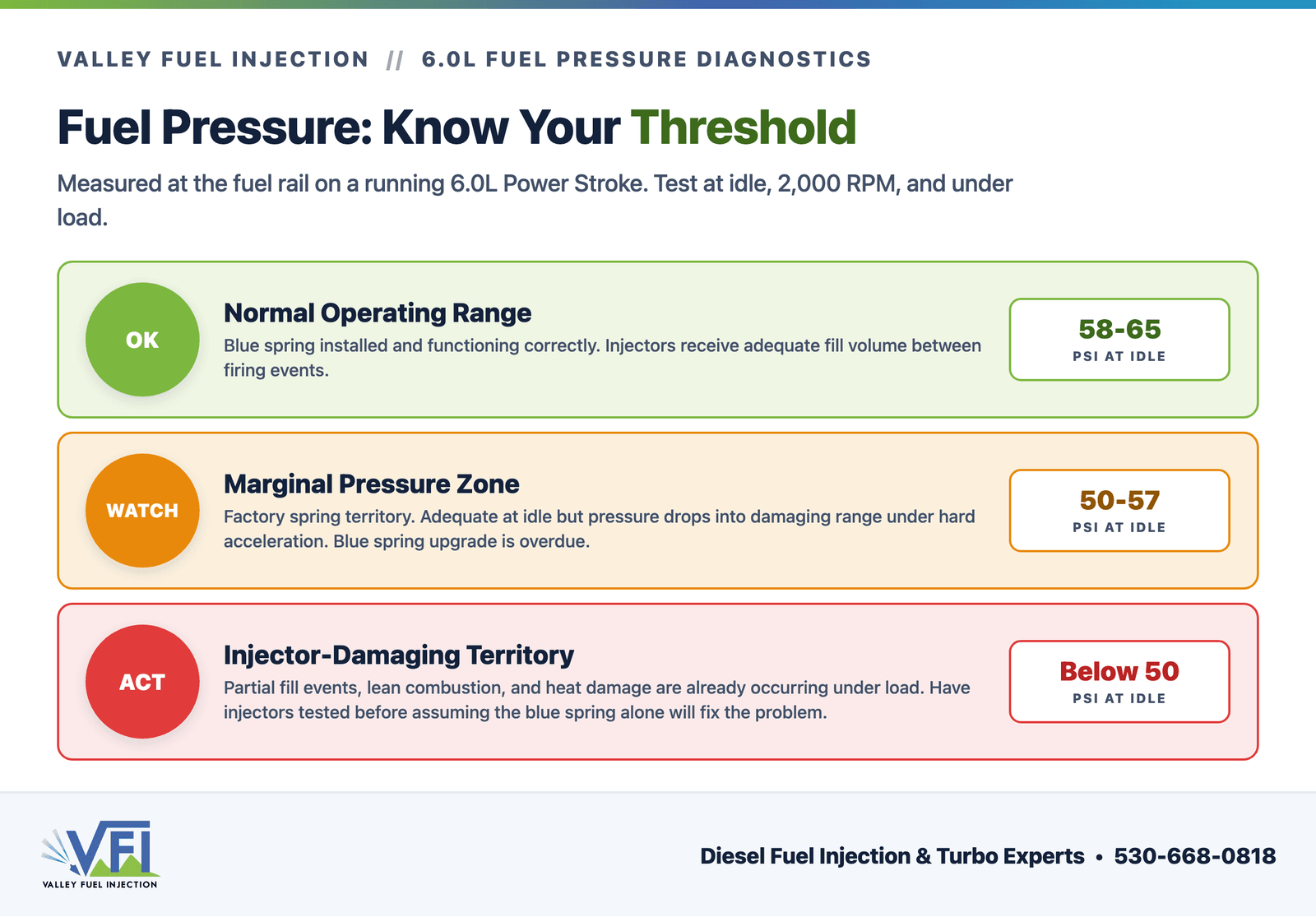
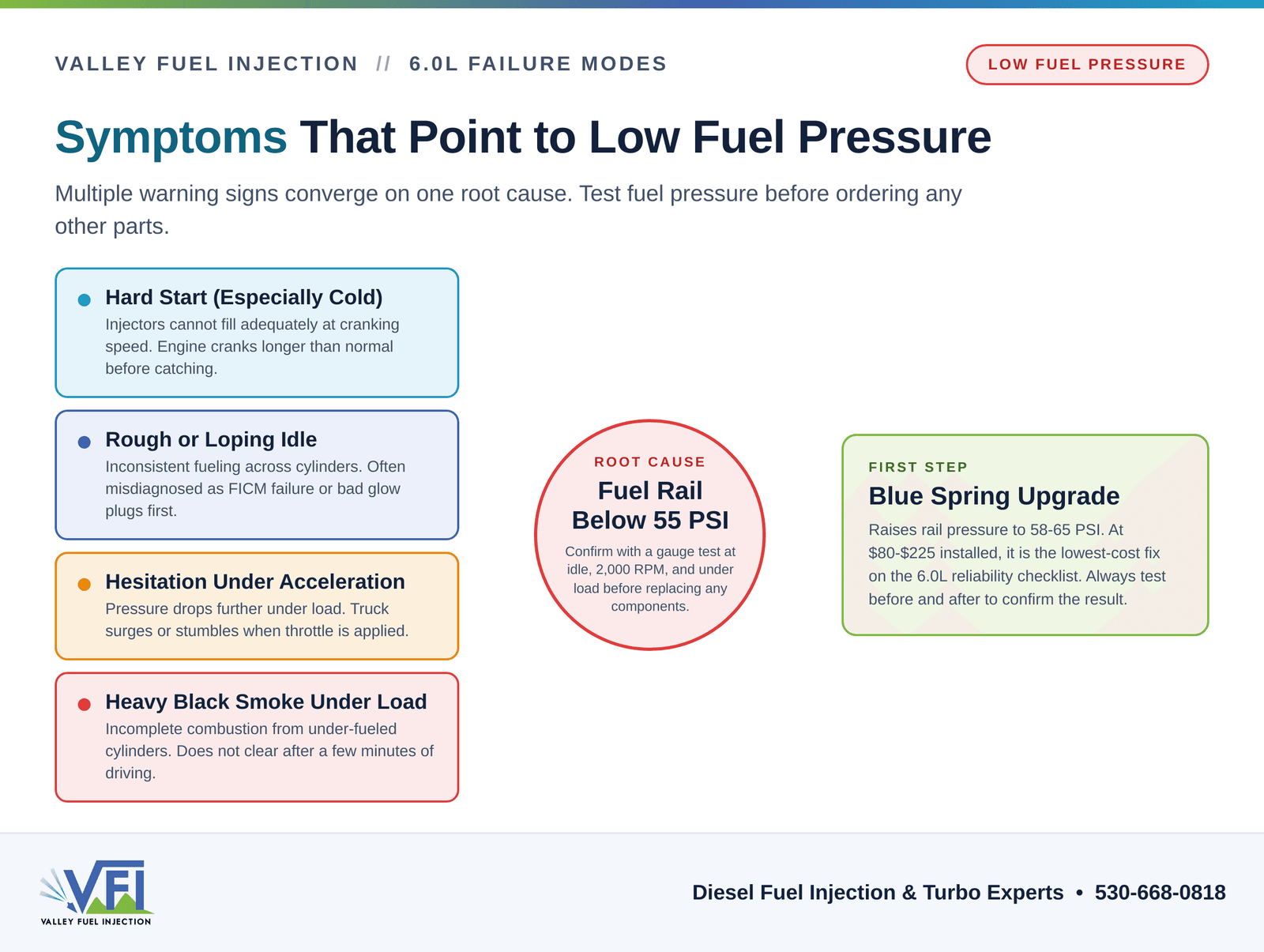
The blue spring upgrade raises fuel rail pressure from roughly 45–50 PSI to 58–65 PSI, giving your 6.0L’s injectors the fuel supply they need to fire correctly. At $80–$225 all-in at a specialty shop, it’s the cheapest insurance you can buy against a $5,500–$8,500 injector replacement bill.
What Is the Blue Spring Upgrade and Why Does the 6.0L Power Stroke Need It?
The blue spring upgrade addresses a known engineering shortfall in the 6.0L’s fuel delivery system. The engine uses a fuel pressure regulator (FPR) mounted inside the fuel conditioning module on the driver’s side of the valley. Ford’s factory spring holds fuel pressure in the 45–50 PSI range at idle and under light load. That sounds adequate, but the 6.0L’s HEUI (Hydraulically actuated Electronically controlled Unit Injector) system is extremely sensitive to supply-side pressure. When demand spikes under load or when the factory spring weakens with age, pressure drops below what the injectors need to fill properly between firing events.
The blue spring (named for the color of the anodized billet housing on most aftermarket kits) replaces the stock spring with one calibrated to hold 58–65 PSI. Some premium kits include an upgraded regulator housing, new O-rings, and a check valve. The result is a more consistent fuel supply across the entire RPM and load range, which is exactly what a high-output common rail-style injector system requires.
Ford actually acknowledged the issue and released a revised fuel pressure regulator spring as a running production change, but millions of trucks left the factory with the original calibration. Owners who don’t know about the fix keep running low pressure until the injectors start failing. You can read more about how the 6.0L fits into the broader landscape of Bosch diesel fuel injection systems we service at our shop.
Buy a fuel pressure test gauge before you order any parts. You want a baseline reading at idle, at 2,000 RPM, and under load. If you’re seeing anything below 55 PSI at idle or below 50 PSI under hard acceleration, the blue spring is overdue. Document the before and after readings so you can confirm the fix worked.
How Does Low Fuel Pressure Kill 6.0 Power Stroke Injectors Prematurely?
Low fuel pressure starves the injectors of the supply they need to refill between firing events, which causes a cascade of mechanical and thermal damage that shortens injector life significantly.
Here’s what actually happens inside the injector when fuel pressure is marginal. The 6.0L’s HEUI injectors use high-pressure engine oil (supplied by the HPOP) to hydraulically amplify injection pressure. But the fuel side of the injector still needs adequate supply pressure to fill the injector cup completely before the next injection event. When supply pressure is low, the injector doesn’t fill completely. The result is partial injection, lean combustion in that cylinder, and heat. Over time, that heat damages the injector’s internal components, especially the nozzle tip and the sac volume.
There’s a second failure mode that’s less obvious. When fuel pressure drops, the injector’s return circuit can allow high-pressure oil to migrate into the fuel system through worn injector seals. That oil contamination then circulates back through the fuel conditioning module, accelerates O-ring degradation, and eventually reaches other injectors. We’ve seen sets of injectors fail in a chain reaction that started with one low-pressure event and a single compromised seal.
A full set of 8 HEUI injectors for a 6.0L F-Series typically runs $5,500–$8,500 installed at a California specialty shop, with parts alone in the $2,800–$3,500 range.
The E-Series van is significantly worse, running $7,000–$10,500 installed because the labor hours jump from 4.5–6 hours to 14–16 hours for the same engine in a van body. Spending $80–$225 on a blue spring kit to protect that investment is not a difficult calculation. Our guide on diesel fuel injector cleaning covers what happens when injectors are neglected long enough to need professional intervention.
Do not ignore a fuel pressure reading below 45 PSI on a running 6.0L. At that level, you’re already in injector-damaging territory under load. If you’re also seeing hard starts, rough idle, or misfires, the injectors may already be compromised. Have them tested before assuming the blue spring alone will fix the problem.
What Symptoms Tell You the Blue Spring Upgrade Is Overdue?
Several symptoms point directly at low fuel pressure on the 6.0L, and most owners have been chasing them with other repairs for months before someone identifies the actual cause.
The most common signs include:
- Hard starts, especially when cold: The injectors can’t fill adequately at cranking speed when pressure is marginal. The engine cranks longer than it should before catching.
- Rough or unstable idle: Inconsistent fueling across cylinders creates the characteristic loping or hunting idle that 6.0L owners often blame on the FICM or glow plugs first.
- Hesitation or stumble under acceleration: Fuel pressure drops further under load, and the injectors respond with inconsistent spray patterns. The truck feels like it’s missing or surging when you get into the throttle.
- Black smoke under load: Incomplete combustion from under-fueled cylinders produces excessive soot. If you’re seeing heavy black smoke that doesn’t clear after a few minutes of driving, fuel delivery is a primary suspect.
- Poor fuel economy: The ECM compensates for misfires by extending injection duration, which burns more fuel without producing proportional power.
- ICP (Injection Control Pressure) codes: Low fuel pressure forces the HPOP to work harder to compensate, which can trigger ICP-related fault codes even when the oil system itself is intact.
It’s worth noting that these symptoms overlap heavily with FICM failure, glow plug problems, and EGR cooler issues. The 6.0L is notorious for stacking problems, and low fuel pressure is often one layer in a multi-cause diagnosis. A proper diagnostic should include a fuel pressure test, an ICP test, and a FICM voltage check before any parts are ordered. Our diesel fuel injection services page covers the full scope of what a diagnostic evaluation includes at our shop.
The 6.0L Power Stroke was produced in partnership between Ford and International Navistar. The fuel conditioning module and its pressure regulator were Navistar components, not Ford-designed parts. That’s part of why the fix didn’t come as a factory recall, the responsibility sat in a gray area between two manufacturers.
What Parts Are Involved and What Does a Proper Install Include?
A complete blue spring upgrade involves more than just swapping the spring. A proper install addresses the entire fuel conditioning module while it’s accessible.
Here’s what a thorough job covers:
| Component | What It Does | Replace At Same Time? |
|---|---|---|
| Blue spring (FPR spring) | Raises and stabilizes fuel rail pressure | Yes, the whole point of the job |
| FPR O-rings | Seal the regulator housing against leaks | Always, they harden and crack with age |
| Fuel filter | Removes particulates before they reach injectors | Yes, module is already accessible |
| Water separator | Pulls water out of fuel before it damages injectors | Yes if overdue |
| Fuel conditioning module O-rings | Prevent external fuel leaks at module housing | Recommended, cheap insurance |
| Lift pump condition check | Confirms adequate supply pressure upstream | Always test, don’t assume |
The parts cost for a basic aftermarket blue spring kit runs $22–$75 depending on the brand and whether you choose a standard or billet-housing version. All-in at a specialty shop, including labor (30–45 minutes for a stand-alone visit), the job typically runs $80–$225. That range widens if the shop supplies a premium OEM-spec or billet kit, or if the work is bundled with other services during the same visit.
For parts, Bosch Mobility and Sinister Diesel are among the commonly referenced sources for quality blue spring kits. The billet-housing versions cost more upfront but resist heat cycling better than stamped-steel housings.
Blue spring upgrade (parts + labor at a California specialty shop): typically $80–$225 for a stand-alone visit. Bundled with a fuel filter service or other scheduled maintenance, the incremental labor cost drops significantly. Parts alone: $22–$75 depending on kit quality.
One important note on lift pump health: the blue spring regulates pressure downstream, but it can’t compensate for a weak lift pump that isn’t supplying adequate volume in the first place. If your lift pump is marginal, the blue spring will help at idle but still fall short under hard acceleration. Our detailed post on diesel lift pumps covers how to diagnose a failing supply pump before it takes injectors with it.
Should You Do the Blue Spring Upgrade Yourself or Have a Certified Shop Handle It?
The blue spring upgrade is one of the more accessible DIY jobs on the 6.0L, but there are good reasons to have a certified shop do it, especially if you’re not already certain about the engine’s current state.
The mechanical side of the job is straightforward. The fuel conditioning module is accessible without major disassembly, and the spring swap itself requires basic hand tools. Plenty of 6.0L owners have done it successfully in a driveway. The SAE International technical literature on HEUI fuel systems confirms that fuel supply pressure is a primary variable in injector service life, so the engineering rationale for the upgrade is well-documented.
Where DIY goes wrong is in what gets skipped. A shop doing this job will pressure-test the system before and after, inspect the O-rings and housing for wear, check lift pump output, and pull any stored fault codes. A driveway mechanic who just swaps the spring and calls it done may miss a degraded O-ring that starts leaking two weeks later, or a lift pump that’s already at the end of its life.
They also won’t have the baseline fuel pressure data to know whether the upgrade actually solved the problem or whether something else is still dragging pressure down.
If you’re already planning to do injectors, standpipes, or dummy plugs at the same time, having a certified shop handle the whole job at once makes even more sense. The labor overlap is significant, and a shop with 6.0L experience will catch secondary issues before they become expensive surprises. Diesel truck owners in the Sacramento area can bring their truck directly to our Woodland shop, and we’re also accessible to owners coming from Sacramento and surrounding areas.
If you’re doing the blue spring yourself, use a torque wrench on the module housing bolts. Over-torquing is the most common DIY mistake on this job and it cracks the housing or deforms the O-ring seat, which turns a $40 fix into a $300 module replacement. Consult a qualified diesel technician if you’re not comfortable with the fuel system disassembly.
What Else Should You Address While You’re In There?
The 6.0L rewards a systematic approach. While the fuel conditioning module is out and the engine is partially apart, several related items are worth addressing to avoid coming back in six months for the next failure.
Standpipes and dummy plugs. These are the fittings that connect the high-pressure oil rail to the injectors. The factory standpipes use a rubber O-ring that degrades and allows high-pressure oil to bypass the injector, causing low ICP pressure and the same hard-start and rough-idle symptoms as low fuel pressure. Replacement standpipes and dummy plugs typically run $200–$450 for the parts, and the labor overlap with injector or HPOP work makes this a natural bundle.
IPR valve inspection. The Injection Pressure Regulator controls high-pressure oil flow to the injectors. A worn IPR causes erratic ICP pressure, hard starts, and surging under load. The IPR is accessible after removing the Y-pipe and turbo surround, and replacement runs $350–$800 installed at a California specialty shop. Given that the symptoms of a bad IPR overlap almost exactly with low fuel pressure, it’s worth testing the IPR before and after the blue spring upgrade to confirm which system was actually causing the problem.
HPOP condition. If the truck has high miles and the HPOP hasn’t been serviced, this is worth evaluating. A failing HPOP won’t be fixed by better fuel pressure, and the two systems work together to deliver proper injection events. HPOP replacement on a 6.0L runs $2,800–$4,500 installed, including parts and California labor rates. Our common rail system repair page covers the broader context of high-pressure fuel system service.
EGR cooler and oil cooler. These aren’t directly related to fuel pressure, but they’re the other two items that define 6.0L reliability. If you’re doing any significant work on the engine, it’s worth knowing the status of both. A clogged oil cooler causes coolant restriction that eventually leads to head gasket failure. A cracked EGR cooler puts coolant into the intake. Neither is cheap to fix after the fact. The EPA’s emission standards documentation provides context on why EGR systems were mandated on these engines, even if the implementation on the 6.0L left something to be desired.
Fuel quality. California’s biodiesel blend requirements affect injector longevity more than most owners realize. High-blend biodiesel has lower lubricity than ULSD and degrades rubber components faster, which matters a great deal for the O-rings in the fuel conditioning module you just serviced. Our post on biodiesel injector damage in California covers this in detail and is worth reading if you’re fueling regularly at California pumps.
If the engine is producing blue smoke alongside these symptoms, that’s a separate diagnostic path that may indicate oil consumption or injector seal failure. Our article on diesel engine blue smoke causes walks through the diagnosis step by step.
Common 6.0L repairs often bundled with the blue spring upgrade: Standpipes/dummy plugs: $200–$450 (parts). IPR valve replacement: $350–$800 installed. HPOP replacement: $2,800–$4,500 installed. Full injector set (F-Series): $5,500–$8,500 installed. Prices reflect typical California specialty-shop ranges. Call VFI at 530-668-0818 for an accurate quote on your specific job.
The 6.0L Power Stroke has a well-earned reputation for complexity, but most of the common failure points are predictable and preventable. The blue spring upgrade is the lowest-cost item on that list, which makes it the logical starting point for any 6.0L owner who wants to protect what’s underneath the valve covers. For additional context on fuel system maintenance best practices, the California Air Resources Board publishes guidance on diesel fuel quality standards that affect long-term injector health.
Ready to Protect Your 6.0L’s Injectors?
At Valley Fuel Injection, we’ve been servicing 6.0L Power Stroke fuel systems for over 30 years. We know exactly where these engines fail and what it takes to stop the cycle. Whether you need a blue spring upgrade, injector testing, or a full HPOP and standpipe service, we have the tools, parts, and certified technicians to do it right.
Call us at 530-668-0818 or schedule a diagnostic. Visit us at 1243 E Beamer St, Suite C, Woodland, CA 95776. We also ship remanufactured injectors and accept mail-in pumps and injectors for testing and rebuilding nationwide.
Frequently Asked Questions About the 6.0 Power Stroke Blue Spring Upgrade
Will the blue spring upgrade fix my 6.0L’s hard start problem?
It depends on what’s causing the hard start. If low fuel pressure is the primary cause, yes, the blue spring upgrade will typically resolve it. But hard starts on the 6.0L can also come from a failing FICM, worn glow plugs, a bad IPR valve, or low ICP pressure from degraded standpipes. The right approach is to test fuel pressure first. If it’s below 55 PSI at idle, the blue spring is a logical first step. If pressure is already adequate, the diagnosis needs to go in a different direction before parts are ordered.
How often should the fuel pressure regulator spring be replaced on a 6.0L?
There’s no fixed interval because the failure mode is gradual rather than sudden. Most experienced 6.0L technicians recommend doing the blue spring upgrade as part of any major fuel system service, or any time the truck comes in with symptoms of low fuel pressure. If you’ve never done it and the truck has more than 100,000 miles, it’s overdue. The cost is low enough that it makes sense to do it proactively rather than wait for symptoms to develop.
Can I do the blue spring upgrade without replacing the whole fuel conditioning module?
Yes. The spring and O-rings are serviceable without replacing the entire module housing. Most quality aftermarket kits include the spring, new O-rings, and installation instructions. You only need to replace the full module if the housing itself is cracked or the check valve seat is damaged. Inspect the housing carefully when you have it out, and replace it if you see any cracks or corrosion around the O-ring seats.
What fuel pressure should I see after installing the blue spring?
After a proper blue spring installation, you should see 58–65 PSI at idle and no less than 55 PSI under hard acceleration. If pressure is still dropping below 50 PSI under load after the upgrade, the lift pump may not be supplying adequate volume. Test lift pump output volume (not just pressure) before assuming the regulator is the remaining problem.
Does the blue spring upgrade affect fuel economy or power output?
Not directly, but restoring proper fuel pressure often produces a noticeable improvement in both. When injectors are starved for fuel, the ECM compensates by extending injection duration or retarding timing, both of which hurt efficiency and power. Bringing pressure back to spec allows the injection system to operate as designed, which typically recovers fuel economy and throttle response that had been gradually degrading. Think of it as restoring baseline performance rather than adding performance.